


Key Takeaways
- Dynamic Risk Control: A trailing stop is a dynamic stop loss that automatically adjusts as the trade moves in your favor, locking in profits while protecting against sudden market reversals.
- Active Risk Reduction: Unlike static stop losses, a trailing stop actively reduces trade risk over time, bringing the risk to breakeven or locking in a guaranteed profit as the trend extends.
- Trailing Stop vs. Loss-Holding: A trailing stop is an active risk-reduction tool. In contrast, “loss-holding” (refusing to cut losses or averaging down on losing trades) exponentially increases risk and frequently leads to catastrophic account blowouts.
- Flexible Strategies: Traders can manage trailing stops actively (manually based on Supertrend, Exponential Moving Averages, or structural swing highs/lows) or automatically via trading platforms like MetaTrader 4 (MT4).
- Technical Requirement: Standard MT4 automatic trailing stops are client-side. Your platform must remain open and connected to the internet to function; otherwise, a Virtual Private Server (VPS) is required to keep trailing stops active.
- Professional Capital Management: Trailing stops should always be paired with strict risk rules, such as risking no more than 2% of capital per trade, and establishing volume-verified entries.
The golden rule of successful trading is deceptively simple: “Cut your losses short and let your profits run.” Yet, executing this rule in the heat of active financial markets is one of the greatest psychological and tactical hurdles a retail trader faces. When a trade starts moving in your favor, a powerful emotional battle begins. Fear whispers that you should close the trade immediately to lock in whatever small gain you have, before the market reverses. Greed, on the other hand, urges you to ignore your risk parameters and hold on for more, often converting a highly profitable position into a substantial loss.
Conversely, when a trade goes wrong, traders often fall into the trap of “loss-holding”—refusing to accept a small loss, hoping the market will eventually turn around, or worse, doubling down via dangerous systems like Martingale or grid averaging. This behavior is the single most common cause of wiped trading accounts.
To bridge the gap between human psychology and mathematical trading discipline, professional traders employ exit strategies that adjust dynamically to market movement. Among these, the trailing stop stands out as one of the most powerful risk management tools. In this comprehensive guide, we will break down the exact mechanics of trailing stops, explore how they compare to fixed take profit levels, and detail how to integrate active and automatic trailing stop strategies into your daily trading plan. We will also contrast this approach with the dangerous retail habit of loss-holding to highlight why active risk management is the true key to long-term profitability.
Register an Exness account NowGet $1,000 Free for beginners
What is a Trailing Stop? Detailed Mechanics
A trailing stop is a dynamic variation of the traditional stop loss order that moves automatically as the market price moves in a profitable direction. The core mechanism is simple: you set a trailing distance (in points, pips, or percentage), and the stop loss maintains that distance behind the market’s peak price. Unlike a static stop loss, which remains locked at a single price level until hit, a trailing stop acts as a one-way ratchet: it moves forward to lock in gains but never moves backward if the market reverses.
To fully understand this concept, let us look at the mechanics of a buy trade and a sell trade separately.
Buy Order Mechanics
Suppose you open a BUY trade on the EUR/USD pair at an entry price of 1.1200. You decide to set a trailing stop with a distance of 30 pips. Immediately upon entry, your initial stop loss is established at 1.1170 (30 pips below the entry price of 1.1200).
As the price fluctuates, the trailing stop responds as follows:
- If the price rises to 1.1230, your stop loss automatically moves upward by 30 pips, locking in breakeven at 1.1200.
- If the price continues to climb to 1.1300, the trailing stop rises along with it, establishing a new stop loss level at 1.1270. At this stage, you have locked in a guaranteed profit of 70 pips.
- If the price suddenly reverses and drops from 1.1300 down to 1.1250, the trailing stop remains completely stationary at 1.1270. It does not move backward to accommodate the loss.
- Once the price touches 1.1270, the trade is instantly closed by your broker. Instead of a potential loss, you walk away with a locked-in profit of 70 pips.

Sell Order Mechanics
On the contrary, if you open a SELL trade on the GBP/USD pair at an entry price of 1.3500 with a trailing stop distance of 20 pips, the initial stop loss is placed above the market at 1.3520.
As the price moves down in your favor:
- If the price drops to 1.3460, the trailing stop adjusts downward to 1.3480, securing a 20-pip profit cushion.
- If the price continues falling to 1.3400, the stop loss drops to 1.3420, locking in 80 pips of profit.
- If the market bounces upward, the stop loss stands still at 1.3420. When the market moves back up to test this level, the order is closed, and you pocket your 80 pips of profit.

By employing a trailing stop, you eliminate the need to constantly monitor charts and manually shift stop loss orders. The trading platform handles the progression, allowing you to participate in major market movements while defining a strict, automated exit point.
Trailing Stop vs. Fixed Take Profit: A Comparative Analysis
Many traders struggle to choose between using a trailing stop and a fixed Take Profit (TP) order. A fixed Take Profit is a target order placed at a specific price level where you want to close your trade and realize profits. Once the market hits this level, the trade is terminated instantly. While a fixed Take Profit is highly effective in certain market conditions, it has distinct limitations compared to a trailing stop.
To help you understand the structural differences between these two methodologies, let us compare their key characteristics side-by-side:
| Feature | Trailing Stop Loss | Fixed Take Profit (TP) |
|---|---|---|
| Profit Potential | Unlimited. Captures large multi-day or multi-week trends. | Capped. Order closes immediately at the predetermined target level. |
| Market Suitability | Highly effective in strong trending markets (bullish or bearish). | Best suited for range-bound, sideways, or consolidation phases. |
| Win Rate Effect | Slightly lower win rate due to early stop-outs on minor pullbacks. | Higher win rate, as targets are hit before trends lose momentum. |
| Risk Reduction | Actively reduces risk as the price moves, locking in breakeven or profit. | Risk remains constant at the initial SL level until the target is hit. |
| Trading Psychology | Requires high discipline to let trends play out without panic during retracements. | Simple “set-and-forget” model; highly reassuring for beginner traders. |
Why do traders love to use Trailing Stop?
In Forex trading, a trader’s account status after a series of trades will fall into the following 5 cases:
- Big loss
- Small loss
- Breakeven
- Small win
- Big win
The first rule of survival in the financial markets is to completely eliminate Big Losses from your account. If you never take a big loss, your trading account can survive almost any market environment. A standard, static stop loss is designed specifically to prevent big losses. However, to build a growing equity curve, simply avoiding big losses is not enough. You must also maximize your frequency of Big Wins.
This is where the trailing stop becomes invaluable. With a fixed Take Profit, your trade is capped, preventing you from capturing massive, multi-hundred-pip trends. When you use a trailing stop, your profit potential is theoretically unlimited. As long as the market continues to print new highs or lows in line with your trend, your trade remains active, and your locked-in profit grows. It is the ultimate tool for turning a standard 2R (Risk-to-Reward) trade into a 5R, 10R, or even 20R monster trade.

Assuming that you trade 10 orders and gain 3 losses (the price hits Stop loss), 3 draws (breakevens), 2 small wins, and 2 big wins. Let us calculate the net result of this series of trades:
- Losses: 3 trades * -20 pips = -60 pips
- Breakevens: 3 trades * 0 pips = 0 pips
- Small Wins: 2 trades * +30 pips = +60 pips
- Big Wins: 2 trades * (+120 pips and +180 pips) = +300 pips
- Net Profit: -60 + 0 + 60 + 300 = +300 pips
In the end, even with a win rate of only 40% (4 wins out of 10 trades), you are still making quite a lot of profits. The mathematics of trading expectancy are heavily tilted in your favor when you use a trailing stop to capture big wins while capping your downside risk.
The Critical Dangers of Loss-Holding vs. Trailing Stops
To truly appreciate the protective power of a trailing stop, we must contrast it with one of the most toxic practices in retail trading: loss-holding. Loss-holding occurs when a trader refuses to accept a losing trade, keeping the position open indefinitely in the hope that the price will eventually return to their entry point. This behavior is driven by a psychological bias known as loss aversion (a key pillar of Prospect Theory, developed by Daniel Kahneman and Amos Tversky). Research shows that the pain of losing is twice as powerful as the pleasure of gaining. To avoid the pain of realizing a loss, retail traders will take highly irrational risks, such as holding losing positions without a stop loss, or doubling down on losing trades.
Let us contrast the mathematical risk profiles of trailing stops and loss-holding side-by-side:
- Risk Profile of a Trailing Stop:
- Price moves in favor: The stop loss is actively adjusted closer to or past the entry point. The total risk on the trade drops to zero, and eventually becomes a locked-in profit.
- Price moves against: The trade is terminated immediately at the predetermined stop loss level. Capital is preserved.
- Psychological State: Calm, structured, and rule-based. The trader accepts the outcome and moves to the next setup.
- Account Longevity: High. Capital is protected, allowing the trader to take advantage of future market opportunities.
- Risk Profile of Loss-Holding:
- Price moves in favor: Minimal impact. The trader is usually just hoping to escape at breakeven after sitting through a massive drawdown.
- Price moves against: Losses accumulate exponentially. The trader’s margin is consumed, and the risk of a margin call or complete account blowout increases by the hour.
- Psychological State: High stress, anxiety, and hope-based decision-making. The trader is trapped in “hope mode.”
- Account Longevity: Extremely short. A single strong trend against the position will eventually wipe out the entire account balance.
Dangerous Retail Traps: Martingale and Grid Averaging
Beginners often turn to Martingale or grid averaging systems because they promise a high win rate in the short term. A Martingale system involves doubling the trade size of a losing trade every time the price moves against you, assuming that a correction will recover all losses. Grid averaging involves opening additional positions at fixed intervals as the market drops. While these systems can work in sideways markets, they are mathematically guaranteed to fail in strong trending markets. Forex trends can run for thousands of pips without a significant pullback. If you double your size or average down in a strong trend, your leverage will quickly exceed your account equity, resulting in a catastrophic blowout.
Safe Risk Management: The 2% Rule and Volume-Verified Entries
Professional trading is built on a foundation of capital preservation. Instead of holding losses or using grid systems, you must implement a strict risk management framework:
- The 2% Rule: Never risk more than 2% of your account balance on a single trade. If your balance is $10,000, your maximum risk per trade must be $200. This ensures you can survive a streak of consecutive losses without destroying your account.
- Positive Risk-to-Reward Ratio: Always aim for a trade structure where the potential profit is at least 1.5 to 2 times larger than the distance to your stop loss.
- Volume-Verified Entries: Avoid entering trades at arbitrary grid levels. Only enter trades when you see structural confluence (e.g., key support/resistance) combined with clear volume confirmation that buyers or sellers are stepping in.
Trailing Stop techniques
There are many techniques for you to use Trailing Stop in Forex trading. But we will divide them into 2 main categories: (1) Active (Manual) and (2) Automatic.
Active Trailing Stop
Active trailing stop means you manually adjust the Stop Loss yourself as the price moves in line with the trend. This is a highly professional way of trading because it relies on real-time market data and structure, rather than a fixed pip distance. Here are three practical examples of active trailing stops:
Use the Supertrend indicator
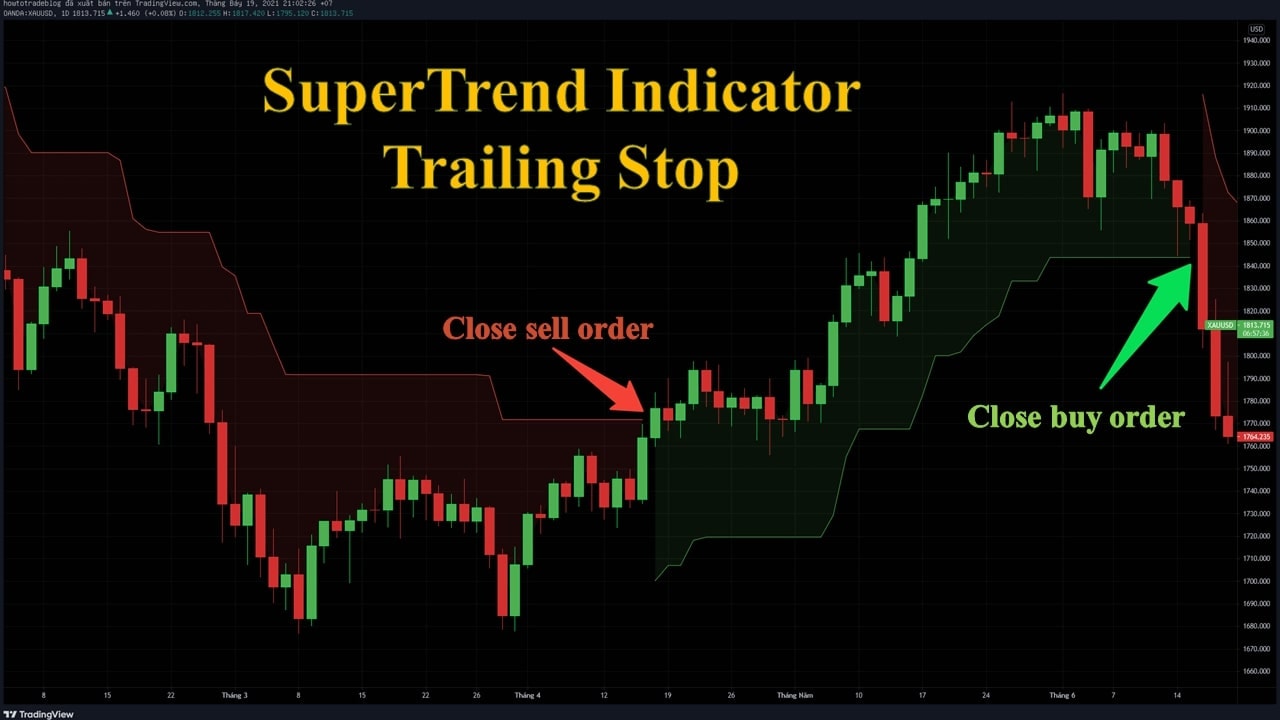
The Supertrend indicator is quite popular among professional traders. It is a trend-following indicator that calculates the market trend by combining volatility (Average True Range) and the median price. It prints a line on the chart that remains below the price during an uptrend (green) and above the price during a downtrend (red). This makes it highly suitable for Swing Traders, specializing in holding long-term orders.
When you use the Supertrend for your trailing stop, your Stop Loss will overlap with the Supertrend indicator line. As the price moves in your favor, the Supertrend line rises (for BUY orders) or falls (for SELL orders). At the close of each candle, you manually update your Stop Loss to match the indicator’s value. When the trend reverses and the price touches or closes on the opposite side of the indicator, your order will automatically close, securing the bulk of the trend’s move.
Use support and resistance levels
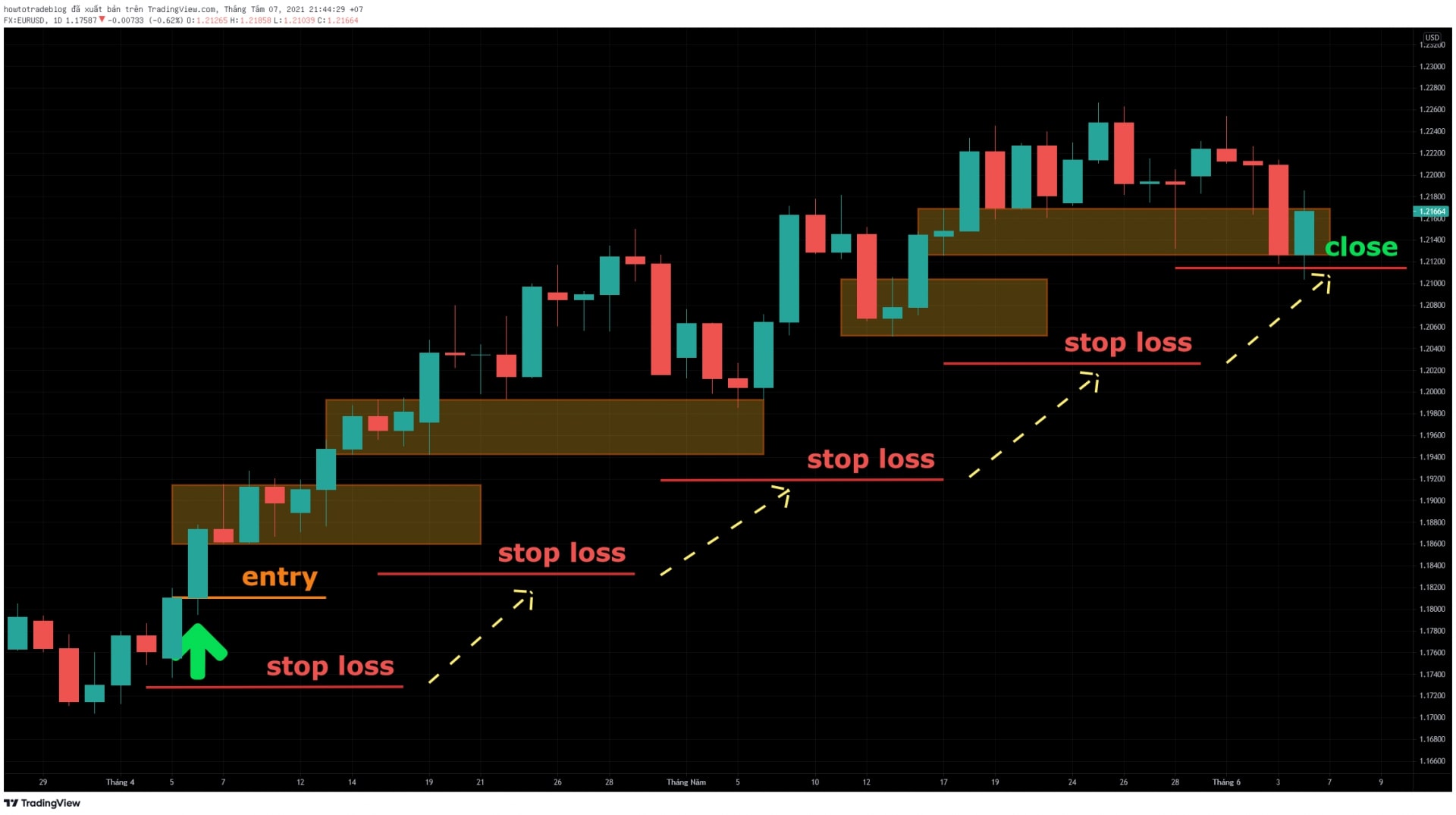
Moving your Stop Loss below or above structural support and resistance levels (market structure) is one of the most robust trailing methods. In a healthy uptrend, the market moves in a zig-zag pattern, creating higher highs and higher lows. In a downtrend, it prints lower highs and lower lows.
For example, in a BUY order, when the price creates a new support zone (higher low) and breaks upward to make a new higher high, you manually change your Stop Loss to just below this nearest support zone. As the trend continues and new support levels are established, you trail your stop from one key level to the next. The market must completely break the nearest support structure (reversing the trend) before your order is hit. This filters out minor market noise and prevents you from being stopped out prematurely.
Use the same method to enter and close an order
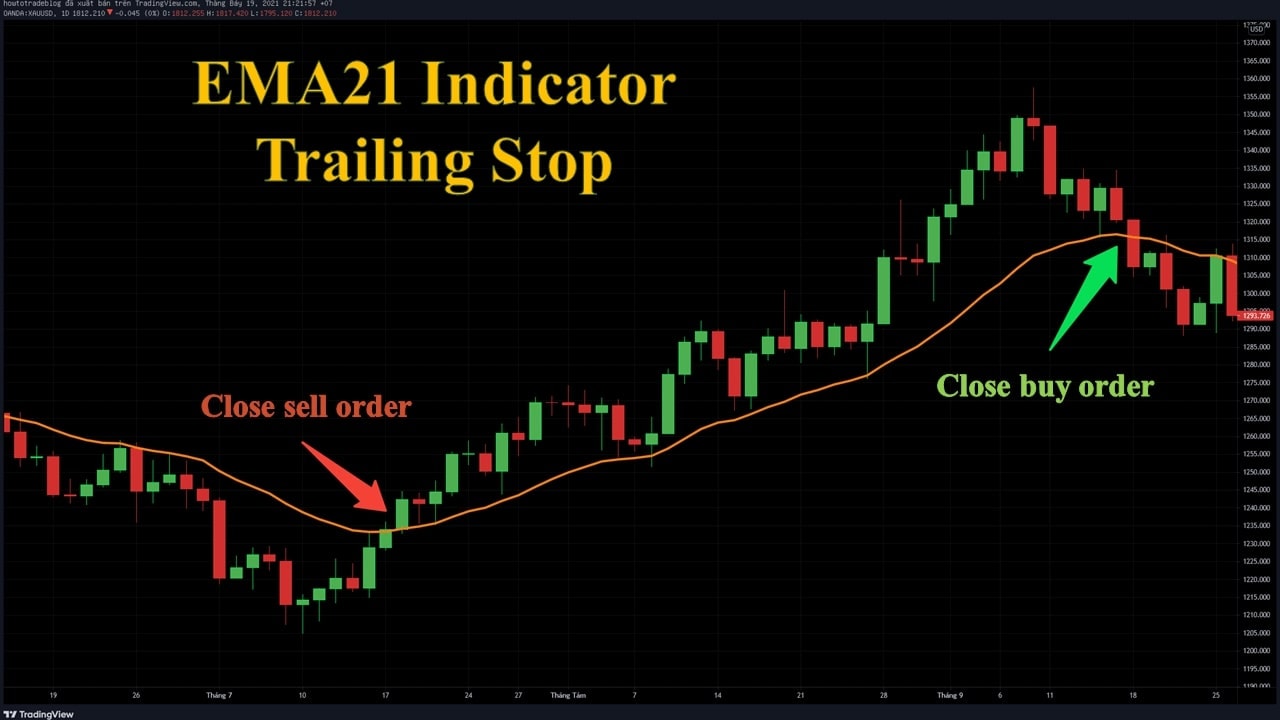
Another common active trailing strategy is to use a dynamic technical indicator like a Moving Average as both your entry trigger and your trailing stop guide. For instance, suppose you are using the 21-period Exponential Moving Average (EMA 21) to trade momentum. The core rule here is that your entry method dictates your exit method.
For example, when the price breaks out of the EMA 21 from below, you open a BUY order, placing your initial Stop Loss below the EMA 21. As the price increases, you manually adjust your Stop Loss following the path of the EMA 21 line at the close of each candle. When the market eventually reverses and the price cuts through the EMA 21 from above and closes below it, your Stop Loss is hit, and the trade is closed. This ensures that you stay in the trade as long as the market momentum remains bullish.
ATR-Based Trailing Stop (Chandelier Exit)
A major flaw of fixed-pip trailing stops is that they do not account for market volatility. A 20-pip trailing stop might be perfect during a quiet Asian session, but it will be easily wiped out during a volatile New York session. To resolve this, professional traders use Average True Range (ATR) to measure volatility and set the trailing distance as a multiple of the ATR (e.g., 2.5x or 3.0x ATR).
By using the ATR, the trailing stop automatically expands during high-volatility environments (preventing premature stop-outs) and contracts during low-volatility environments (locking in profits faster). This strategy is commonly executed via indicators like the Chandelier Exit, which continuously projects a trailing stop line at a set multiple of ATR below the highest high of the trade.
Automatic Trailing Stop
If you do not want to manually adjust your stop loss at the close of every candle, you can use the built-in automated trailing stop feature on trading platforms like MetaTrader 4 (MT4). You set a fixed number of points for your trailing stop, and the software will automatically adjust the stop loss line as the price fluctuates.
For instance, suppose you buy EUR/USD and set an automatic 20-pip Trailing Stop. If the price goes up by 20 pips, your Stop Loss will automatically move up to your entry point (breakeven). If the price climbs further, the stop loss will continue to trail behind the peak price by exactly 20 pips. If the price drops, the stop loss will remain stationary, waiting for the price to hit it and close the trade.
To configure an automatic trailing stop in MT4, follow these steps:
- Open a trade (or select an existing profitable position). Right-click on the order in the “Terminal” window at the bottom of the MT4 desktop platform.
- In the context menu, select Trailing Stop, and then select Custom….
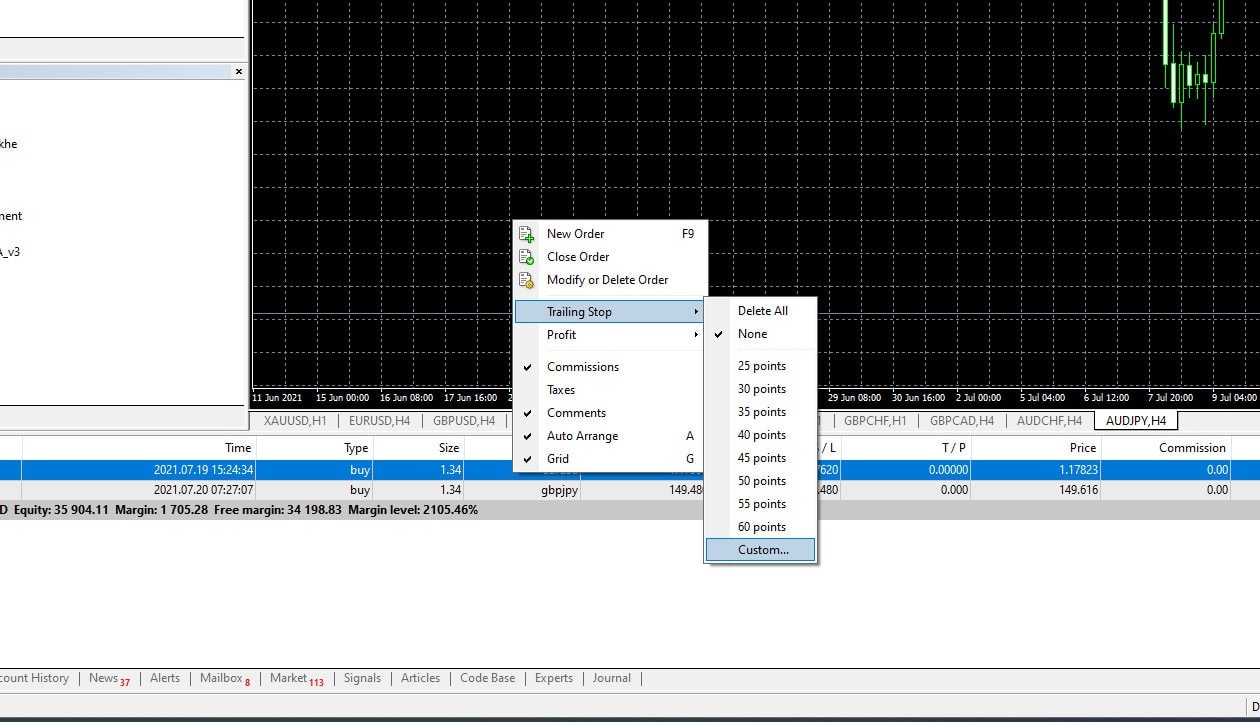
At the custom setting dialog box, enter the desired number of points. In MT4, points are used instead of pips. Since most major currency pairs are quoted to 5 decimal places, 1 pip equals 10 points. If you want to set a 20-pip trailing stop, you must enter 200 points in this field.
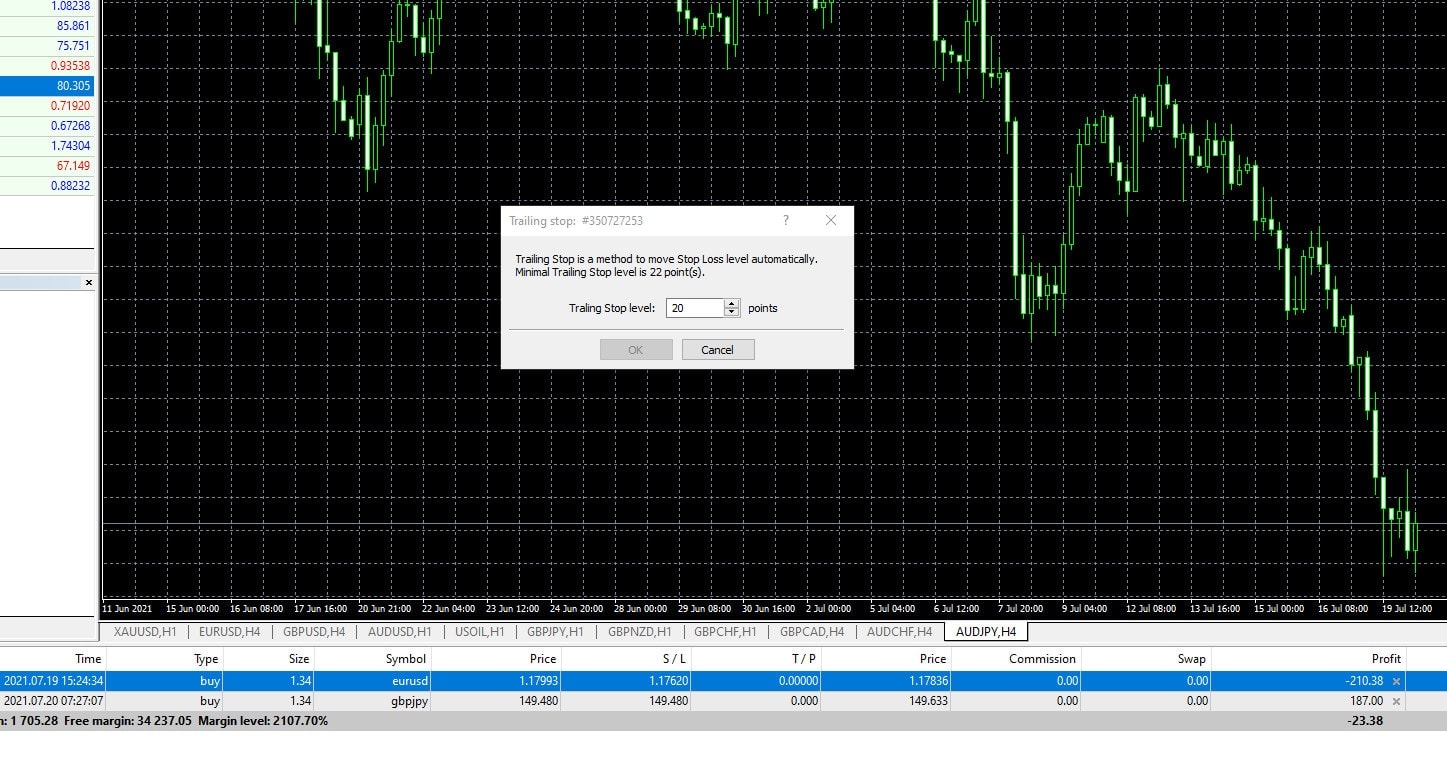
CRUCIAL TECHNICAL WARNING: The automatic trailing stop in MT4 is a client-side feature, not a server-side feature. When you place a standard Stop Loss or Take Profit order, it is stored directly on your broker’s server. Even if your computer is turned off, the broker will execute those levels. However, the automatic trailing stop calculation is performed by your local MT4 software. This means your computer must remain active, the MT4 platform must be open, and your internet connection must remain stable and connected continuously for this function to work. If you turn off your PC, let it go to sleep, or lose internet connectivity, the trailing stop will freeze. The last updated stop loss level will remain on the broker’s server as a standard static stop loss, but it will no longer trail the price. To solve this, professional traders use a Virtual Private Server (VPS) to host their MT4 platform 24/7, ensuring uninterrupted trailing stop performance.
How to Choose the Right Trailing Stop Distance
Choosing the correct trailing stop distance is a delicate balancing act that depends on your trading style, time frame, and current market volatility. If you set your trailing distance too tight, the normal, minor fluctuations of the market will trigger your stop and exit the trade prematurely before the main trend has a chance to develop. On the other hand, if you set the trailing stop too wide, you will give back a massive portion of your paper profits before the stop is hit, severely reducing the efficiency of your strategy.
A highly recommended methodology is to base your trailing stop on market volatility by utilizing the Average True Range (ATR) indicator. ATR measures the average range of price movement over a set period (typically 14 candles). By checking the ATR value on your specific trading timeframe and using a multiplier (such as 2.0x or 3.0x ATR), your trailing distance dynamically adjusts to the current market environment. This ensures your stop is wide enough to survive standard market fluctuations while remaining tight enough to lock in profits once a reversal begins.
Conclusion
The trailing stop is a cornerstone of professional capital management and trading psychology. By transforming your static stop loss into a dynamic, profit-locking mechanism, it systematically enforces the golden rule of trading: cutting losses short while allowing profits to run. It removes the emotional pressure of having to decide exactly when to close a winning position, letting the market structure make that decision for you.
However, to make the trailing stop work, you must avoid high-risk retail traps like loss-holding, grid averaging, and Martingale systems. Combine your trailing stop strategy with a strict risk management framework—such as the 2% capital risk rule and volume-verified entries—to ensure that your account can survive any market condition. Whether you choose to adjust your stop loss manually based on indicators like the Supertrend or EMA 21, or automate the process on MT4 using a VPS, mastering the trailing stop is a vital step toward long-term profitability.
Register an Exness account NowGet $1,000 Free for beginners
Frequently Asked Questions (FAQ)
Can I use an automatic trailing stop on the MetaTrader 4 (MT4) mobile app?
No. The built-in automatic trailing stop feature is a client-side function that is only supported on the desktop version of MT4 (PC or Laptop). The mobile applications for iOS and Android do not support automatic trailing stops. However, if you set an automatic trailing stop on your desktop platform (or via a VPS-hosted platform), the broker will update the static stop loss level on their server. You will be able to see these updated stop levels on your mobile app, but you cannot initiate or configure the automatic trailing action directly from your phone.
What is the best indicator to use for an active trailing stop?
There is no single “best” indicator, as it depends on the market structure. However, the most widely respected tools among professional swing traders are the Supertrend indicator, the Chandelier Exit (which is ATR-based), and standard Exponential Moving Averages (like the EMA 21 or EMA 50). Moving averages are highly effective for fast-moving, parabolic trends, while ATR-based indicators like the Chandelier Exit are superior for normal, volatile trend structures because they dynamically expand or contract the stop based on current volatility.
What is the danger of setting a trailing stop too tight?
The primary danger of a trailing stop that is too tight (e.g., 5-10 pips on daily charts) is premature stop-out. Financial markets do not move in straight lines; they fluctuate and pull back constantly as part of standard price action. If your trailing stop is too tight, a normal intraday pullback will trigger your stop loss, closing your trade before the market resumes its major trend. This results in small gains and prevents you from capturing the large wins required to sustain your account balance.
How does a trailing stop differ from a traditional stop loss?
A traditional stop loss is static: once you set it, it remains fixed at that exact price level until you manually modify it or the market hits it. It only acts as a downside cap. A trailing stop is dynamic: it begins as a standard stop loss but automatically moves in the direction of the trade as the price increases (in a BUY) or decreases (in a SELL). While both protect against losses, the trailing stop also acts as a profit-locking mechanism, adjusting to the trend in real-time.
Will my trailing stop work if my trading platform is offline?
If you are using an automatic trailing stop on MT4 desktop, it will NOT work while your platform is offline or closed. The calculations and orders are executed by your local trading platform client. If the platform is disconnected from the internet, the stop loss will remain static at the last value updated before you went offline. To ensure your trailing stop updates continuously 24/7 without needing your personal computer to be online, you should run your MetaTrader terminal on a Virtual Private Server (VPS).


The whole idea of a trailing stop in forex sounds kinda sus tbh, like its too perfect to actually work in real market conditions. Speaking of market conditions, i always wonder why these platforms push these tools when the actual volatility often eats right through them imo.