


🔑 Key Takeaways
- Compliance Rules: eToro’s Terms of Service strictly prohibit high-frequency micro-scalping. Violators face account restrictions or suspension.
- Spread Impact: Since eToro uses a spread-based model, trading targets of 2-5 pips are mathematically unprofitable.
- Safer Alternative: Use intraday momentum trading on the M5/M15 charts, holding positions for 15 minutes to several hours.
- Risk Control: Follow the 2% rule and a 1:2 Risk-to-Reward ratio. Never use Martingale or average down on losing trades.
- Virtual Practice: Master setups using eToro’s free $100,000 virtual portfolio before trading with real capital.
Speed is one of the most powerful psychological attractions in modern financial markets. The prospect of entering a trade, capturing a quick profit, and exiting within minutes is highly appealing to retail traders. Among short-term market participants, the scalping strategy etoro approach is frequently sought after. It promises fast-paced action, instant feedback, and the potential to accumulate profits through dozens of micro-transactions throughout the day. However, short-term trading is a double-edged sword. It requires absolute concentration, lightning-fast execution, and a deep understanding of market mechanics. While it is possible to generate profits quickly, it is equally easy to blow through an account if you do not understand the rules of the platform you are trading on.
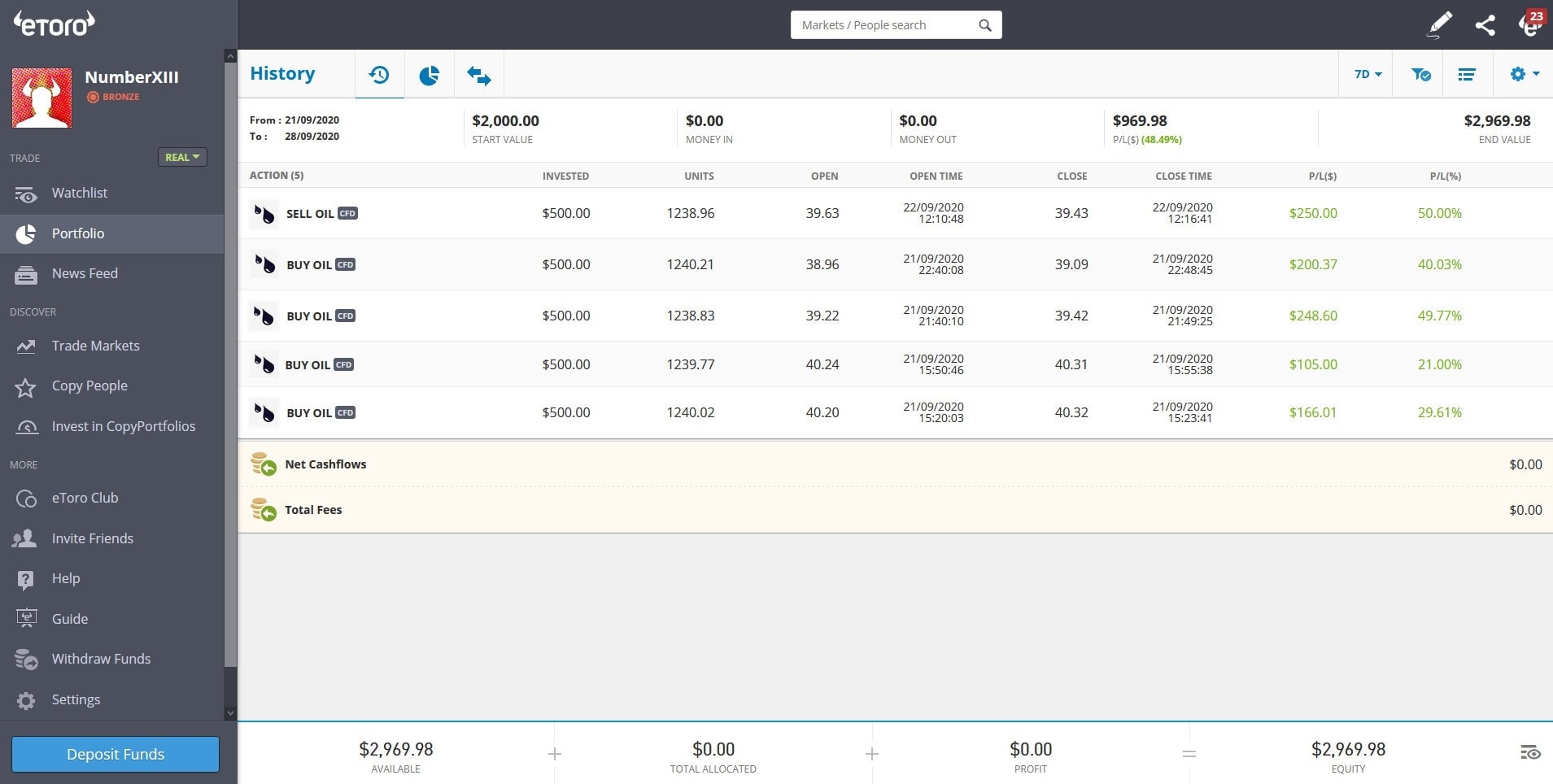
In this comprehensive guide, we will dissect the realities of short-term trading on eToro. We will review a real-world case study where a trader achieved $970 in profit across five distinct transactions using short-term setups. More importantly, we will examine the technical, mechanical, and regulatory hurdles you must overcome to trade short-term successfully on eToro. From the impact of spread-based pricing to the strict boundaries set by eToro’s Terms of Service, this guide serves as your roadmap to building a compliant, high-probability intraday strategy.
Register an eToro Account NowGet $100,000 Free for beginners
Can You Scalp on eToro? Understanding the Terms of Service (ToS)
Before diving into charts, technical indicators, and entry signals, every trader must address a critical regulatory question: Is scalping actually allowed on eToro? The short answer is: No, traditional high-frequency micro-scalping is not permitted, and attempting it can lead to severe account restrictions.
According to eToro’s global Terms and Conditions, the platform actively monitors account behavior for trading patterns that are classified as “scalping” or “latency abuse.” eToro defines prohibited scalping as a trading behavior in which positions are opened and closed within seconds or a few short minutes to exploit tiny price movements or temporary price feed latencies. Because eToro functions under a market maker model and acts as the counterparty to your trades, it must manage its exposure. When retail traders execute rapid-fire orders in seconds, it disrupts the pricing engine and creates significant execution risks, especially when followers are replicating those trades through eToro’s signature CopyTrader system. If you copy a scalper, execution delays could cause massive slippage for the followers, leading to heavy losses.
If eToro’s automated compliance systems detect that your account is consistently opening and closing positions within seconds, your trading activity may be flagged. This can result in warnings, restricted access to leverage, and potentially ending in the permanent suspension of your account and the withholding of profits generated through prohibited activities. Therefore, if you want to trade on short-term charts on eToro, you must adapt. You cannot use high-frequency trading bots or enter and exit trades within seconds. Instead, you must transition to a style of intraday momentum trading—holding positions for at least 15 to 30 minutes, and preferably several hours—to remain fully compliant with the platform’s regulatory framework.
The Mechanical Hurdles of eToro: Spreads, Slippage, and Fees
Even if eToro’s Terms of Service did not restrict ultra-fast scalping, the structural design of the platform makes micro-scalping mathematically unprofitable for retail traders. Understanding these mechanical barriers is essential for protecting your capital.
How Spreads Eat Into Short-Term Profits
Unlike ECN brokers that charge a flat commission per trade and offer raw market spreads (often as low as 0.0 to 0.2 pips), eToro uses a spread-only fee model for most assets. This means eToro makes its money by adding a markup to the buy (ask) and sell (bid) prices. For example, if you are trading EUR/USD, the spread might hover around 1.0 pip. If you are trading popular stock CFDs, indices, or cryptocurrencies, the spreads are wider.
For a swing trader targeting a 150-pip gain, a 1-pip spread is a negligible cost of doing business. However, for a micro-scalper targeting a 5-pip gain, a 1-pip spread means starting the trade with a 20% deficit. The price must move 1 pip in your favor just to break even, and a total of 6 pips to secure your 5-pip target. If the market turns against you by just a few pips, your stop-loss will be triggered. Over hundreds of trades, the spread cost accumulates rapidly, acting as a massive drag on your account equity. Therefore, any viable short-term strategy on eToro must target larger intraday swings (20 to 50 pips) to make the spread costs negligible.
Execution Speed and Slippage
Scalping requires direct market access (DMA) and instantaneous execution. eToro is optimized for social copy trading and retail investing rather than high-frequency execution. During periods of high market volatility—such as major economic news releases or the opening bells of the London and New York sessions—the platform can experience minor latency. This lag between clicking the button and order execution leads to slippage. If you are filled even half a pip worse than your intended entry, your profit margin on a micro-trade can be completely wiped out.
Understanding Leverage Caps and Capital Limits
To amplify small price moves, short-term traders often use leverage. eToro offers leverage on CFD trades, but retail traders are bound by strict regulatory limits (such as ESMA rules in Europe and ASIC rules in Australia). Under these rules, leverage is capped at x30 for major currency pairs, x20 for gold and major indices, x5 for individual stock CFDs, and x2 for cryptocurrencies. When trading with leverage on eToro, you must remember that your margin is highly sensitive to spread costs and sudden market spikes. A high-leverage trade can hit a tight stop-loss in seconds due to a temporary spread widening, even if the price eventually moves in the predicted direction.
The Smart Alternative: Intraday Momentum Trading on M5/M15 Charts
To trade successfully and remain within eToro’s boundaries, you must shift your focus. Instead of trying to capture 2-3 pips on the 1-minute (M1) chart inside a few seconds, you should implement intraday momentum trading. This approach uses the 5-minute (M5) and 15-minute (M15) timeframes to identify strong trends and clean breakouts, holding positions for 15 minutes to 4 hours.
By targeting larger, volume-verified swings of 20 to 50 pips, you accomplish three major goals:
- ToS Compliance: Your average trade holding time exceeds eToro’s safety margins, keeping your account safe from compliance flags.
- Spread Mitigation: The spread fee becomes a tiny fraction of your target profit, restoring a positive expectancy to your mathematical model.
- Noise Reduction: The M5 and M15 timeframes filter out the chaotic market noise of the M1 chart, leading to higher-quality technical setups.
To execute this strategy effectively, you should trade only during high-liquidity trading windows. The most optimal period is the London/New York session overlap (typically 12:00 to 16:00 GMT). During these hours, trading volume peaks, spreads contract to their tightest levels, and clear trends emerge, providing the momentum needed to carry your trades to their profit targets quickly without hitting overnight holding fees.
Reviewing the Five-Order Setup: Case Study Analysis
To understand how to apply short-term technical analysis, let’s review a real-world case study of a trading session that generated $970 in profits across 5 distinct orders using support, resistance, and the Relative Strength Index (RSI). Note that in this case study, while the execution was fast, a professional approach would extend the holding times to align with the safety margins discussed above.
Trading Conditions and Setup
The session was conducted by monitoring Japanese candlestick charts across the 1-minute (M1), 5-minute (M5), and 10-minute (M10) timeframes. The Relative Strength Index (RSI) was active to track momentum and identify temporary exhaustion points. The trader used an exposure structure representing x5 leverage (500% exposure of the margin), with a tight stop-loss set at 25% of the allocated margin, and a maximum take-profit target at 50% ($250 per trade). The key to this strategy was flexibility—exiting early when the momentum indicators signaled a trend slowdown rather than greedily waiting for the hard take-profit line.
Order 1: RSI Oversold Reversal
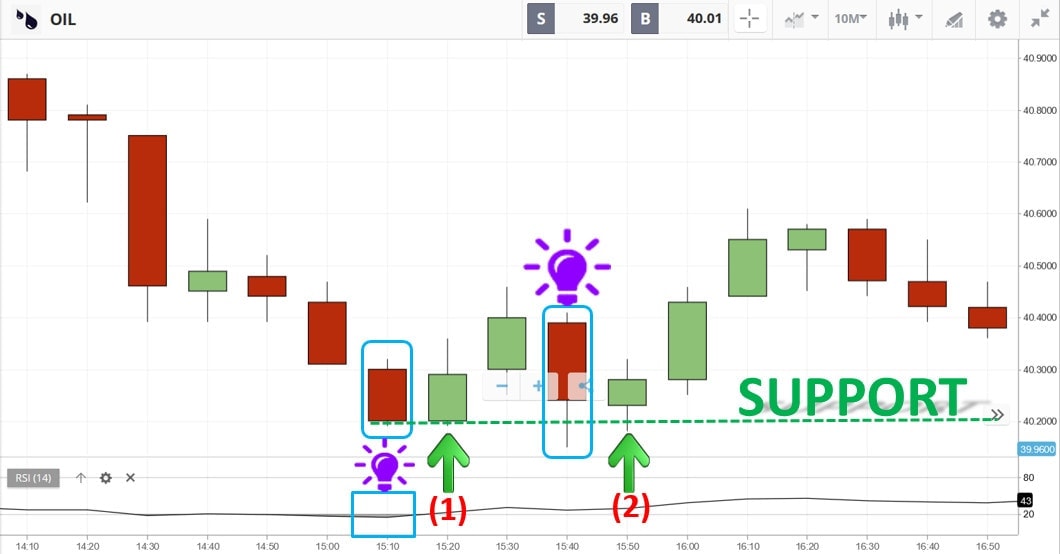
The first order was a Buy trade. On the M5 chart, the price had experienced a rapid downward push, driving the RSI line deep into the oversold zone (below 30). This indicated that sellers were temporarily exhausted. As the M1 chart began to print a small bullish rejection candle, the trader entered a Buy order. By capturing the immediate mean-reversion bounce as buyers stepped back into the market, the trade quickly moved into profit, allowing for a swift exit.
Order 2: Double Bottom Support Retest
Following the exit of the first order, the price pulled back again to retest the recent low. This level acted as a strong horizontal support zone (corresponding to the oversold region of the first trade). As the price touched the support line and began to rebound, forming a micro-double bottom pattern, the trader executed the 2nd Buy order. Waiting for verification that the support level was holding, rather than guessing the bottom, is a classic high-probability setup.
Order 3: RSI Momentum Exhaustion Buy
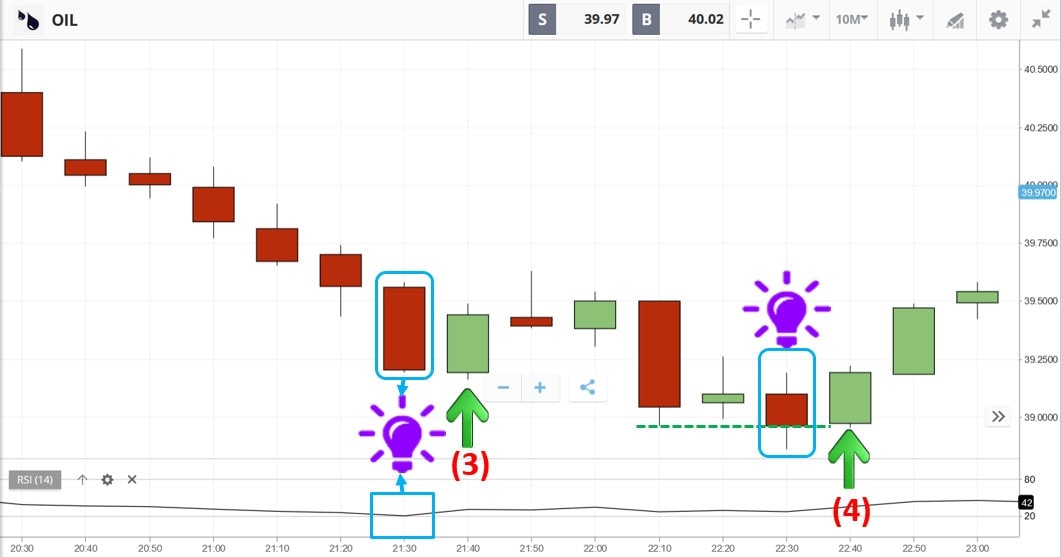
The 3rd order was another Buy trade. During a minor consolidation phase, the candlesticks began to show signs of exhaustion—small bodies with long lower wicks. Meanwhile, the RSI indicator hovered just above the 30 oversold line but refused to break lower, indicating that sellers lacked the momentum to push prices down. Recognizing this exhaustion, the trader entered a Buy order to ride the next upward impulse wave.
Order 4: Multi-Touch Support Retest
The price returned to the horizontal support zone for a third time. In price action trading, a support level often weakens the more times it is tested. However, if the volume-verified price action shows immediate rejection (long wicks forming at the support line), it indicates that buy orders are still sitting in the order book. The trader executed a 4th Buy order at this support zone, capturing a rapid, short-term bounce as the price defended the level once more.
Order 5: Support Breakout and Trend Reversal Sell
After multiple retests, the buying interest at the support line was fully absorbed. On the 5th attempt, sellers broke through the support level with a strong, full-bodied bearish candle. The old support level immediately transitioned into a new resistance level. The trader adapted to this structural market shift and opened a 5th trade: a Sell order. Riding the breakout momentum of a broken support zone is one of the most reliable ways to capture rapid intraday trends, as panic selling often accelerates the downward move.

eToro Scalping vs. Swing Trading: A Comparative Analysis
To help you choose the style that matches your lifestyle, capital, and eToro compliance requirements, look at the comparison table below:

Essential Technical Indicators for Intraday Trading on eToro
To successfully navigate the fast-moving intraday markets, you must rely on a reliable suite of technical tools. These indicators help remove emotion from your execution, providing clear rules for entry and exit.

1. The Stochastic Oscillator
The Stochastic Oscillator is often used to identify trend reversals by tracking overbought and oversold conditions. It consists of two lines—%K and %D—moving between 0 and 100. The standard settings are 14, 3, 3, with overbought at 80 and oversold at 20. In short-term trading, a cross of the %K above %D from below the 20 level signals a buy opportunity. A cross of the %K below %D from above 80 indicates a sell opportunity. Short-term traders should align these signals with structural support and resistance levels to filter out market noise.
2. The Relative Strength Index (RSI)
The RSI measures momentum speed and change on a scale of 0 to 100. Standard levels are 70 (overbought) and 30 (oversold). Beyond these basic signals, advanced intraday traders use RSI Divergence. If the price prints a new low while the RSI prints a higher low (bullish divergence), it indicates sellers are losing momentum, hinting at an imminent reversal. Divergences provide high-probability setups that help you avoid chasing false breakouts.
3. The Ichimoku Cloud (Kinko Hyo)
The Ichimoku Cloud is an all-in-one indicator that defines support/resistance, trend direction, and momentum. In intraday trading, the “Cloud” (Kumo) acts as a trend filter. If price resides above the Cloud, focus on buy setups; if below, focus on sell setups. A breakout above or below the Cloud on the M5 chart provides an entry trigger with a logical stop-loss on the opposite side of the Kumo boundary.
4. Price Action and Candle Patterns
Candlestick patterns are critical for entry confirmation. A Pin Bar (long tail, small body) at support indicates aggressive buying pressure. An Engulfing Candle (a large body covering the previous candle) shows a clean shift in market control. Always wait for the candle to close on your execution timeframe before opening an order; entering during an active candle often leads to bad fills.
Strict Capital Preservation: The 2% Rule vs. Dangerous Betting Systems
Trading is a business of probabilities. Even with high-probability setups, losing trades will occur. Successful intraday trading relies on strict risk control to ensure no single loss damages your account long-term.

The 2% Position Sizing Rule
Under the 2% rule, you never risk more than 1% to 2% of your total account balance on a single trade. If your account contains $5,000, your maximum risk per trade (entry to stop-loss multiplied by position size) is $100. This ensures that even a 5-trade losing streak only results in a 10% drawdown, leaving 90% of your capital intact to recover. It keeps your emotions steady during temporary market setbacks.
A Direct Warning: The Toxic Illusion of the Martingale System
Many novice traders try to recover losses by using the Martingale system—doubling their position size after every loss. The logic is that one win recovers all losses. In practice, Martingale is a guaranteed way to blow up your account. A sequence of 6 losses (common in volatile market phases) turns a $100 initial risk into a $6,400 risk on the 7th trade. Very few retail accounts can support this exponential risk growth before hitting leverage limits or margin calls. **Never use Martingale on short-term trades.**
The Danger of Averaging Down
Similarly, averaging down (adding to a losing position as the price moves against you) is toxic in leveraged short-term trading. If you buy EUR/USD and the price declines, adding buy orders assumes the market must correct. However, strong trends can run hundreds of pips without looking back, resulting in rapid margin liquidations. A professional trader accepts the loss, hits the stop-loss, and moves on.
The Math of Longevity: Risk-to-Reward (R:R) Ratio
Always maintain a positive Risk-to-Reward (R:R) ratio, ideally at least 1:2. If you risk $50 to make $100, you only need to win 34% of your trades to break even. A negative R:R ratio (risking $100 to win $20) creates a fragile system where a single loss wipes out multiple wins. Positive expectancy is the foundation of long-term trading survival.
Psychology and Discipline: Navigating the Roller Coaster
Trading short-term timeframes is a major psychological challenge. Because you are opening and closing positions rapidly, your brain is exposed to a constant stream of dopamine hits and stress signals. It is very easy to fall into the trap of emotional trading.

The two main psychological enemies of the intraday trader are:
- Greed (FOMO): Watching a price jump and chasing it without a valid technical setup. This usually results in buying at the absolute top of the move right before a correction.
- Revenge Trading: After hitting a loss, immediately opening a larger position in the opposite direction to win back the money. This lacks a logical setup and is driven purely by anger, often leading to a rapid sequence of losses.
To survive, you must treat trading as a business. Keep a strict trading journal detailing every entry, exit, setup, and emotion. If you hit your daily loss limit (typically 4% of your total account value), close the platform and walk away. The market will always be there tomorrow.
Register an eToro Account NowGet $100,000 Free for beginners
Conclusion: Developing a Compliant and Profitable Trading Strategy
Short-term trading on eToro can be highly engaging, but traditional high-frequency micro-scalping is prohibited by the platform’s Terms of Service and made mathematically unviable by spread costs. The key to success is adapting your strategy to compliant intraday momentum trading.
Focus on the M5, M15, and M30 timeframes. Trade during high-liquidity overlaps when spreads are tightest. Structure your entries around clean breakout zones and verified support/resistance rebounds, and use momentum indicators like the RSI and Stochastic to spot exhaustion points. Most importantly, adhere to a strict risk management framework—use the 2% position sizing rule, maintain a positive Risk-to-Reward ratio, and avoid destructive systems like Martingale. Before risking real money, practice your strategy on eToro’s virtual portfolio to build the discipline needed to survive in the markets.
Frequently Asked Questions
Is scalping allowed on eToro?
No, traditional high-frequency scalping where positions are opened and closed within seconds or under a few minutes is not allowed on eToro. eToro monitors accounts for latency arbitrage and rapid execution patterns. To comply with their Terms of Service, traders should use an intraday momentum style, keeping trades open for at least 10 to 15 minutes, or several hours.
How do spreads impact short-term trading on eToro?
eToro charges a spread (the difference between the buy and sell price) instead of commissions on CFD trades. Since you start each trade in the negative by the amount of the spread, targeting tiny profits (e.g., 2-5 pips) is mathematically disadvantageous. To make the spread fee negligible, intraday traders should target larger price swings of 20 to 50 pips on the M5 or M15 charts.
Can I use leverage for short-term trades on eToro?
Yes, eToro allows you to trade CFDs with leverage. However, leverage is capped based on your jurisdiction and asset class under regulations like ESMA (e.g., x30 for major Forex, x20 for Gold and major indices, x2 for crypto). While leverage increases buying power, it also multiplies losses and makes you highly sensitive to spread costs and volatility.
Is the Martingale strategy recommended for day trading?
No, the Martingale strategy (doubling position size after a loss) is extremely dangerous and highly discouraged. A brief losing streak can cause exponential risk increases, quickly exceeding your account balance or the broker’s leverage limits, leading to a complete margin liquidation. Professional traders should instead use a static risk percentage, like the 2% rule.
How does the eToro virtual portfolio help with strategy development?
eToro provides all users with a free $100,000 virtual/demo portfolio. This allows you to practice technical entries, monitor how spreads affect your returns, understand the speed of platform execution, and build strict trading discipline without exposing real capital to the market.




Scalping on etoro just feels like its gonna lead to losses for the average person, i dont buy it. That stuff never works long term anyway.