


Time is gold, and that’s true in life and in trading. You will certainly have plenty of time while still ensuring profits when using the Day Trading style in eToro. The review on making $990 will be proof that making “Gold” is very simple when you are a Day Trader. However, day trading on eToro is not a simple game of guessing market directions; it requires a highly structured routine, advanced technical setups, and an unwavering commitment to strict risk management protocols.
Key Takeaways
- CFD Trading Environment: Day trading on eToro heavily relies on Contract for Differences (CFDs), which allow short-term speculation on both rising and falling markets.
- Leverage Capping: Regulatory bodies like ESMA enforce strict leverage limits (e.g., 30:1 for Forex, 5:1 for Stocks) to protect retail traders from sudden, catastrophic capital losses.
- Cost Management: Day trading incurs frequent costs through bid-ask spreads and potentially overnight rollover fees (swap fees) if positions are held past daily close times.
- Safe Risk Principles: Avoid account-destroying systems like Martingale or grid averaging. Instead, enforce the 2% maximum risk rule per trade and target a minimum 1:2 Risk-to-Reward ratio.
- Proven Strategies: Combining volatility indicators like Bollinger Bands with key horizontal support and resistance levels helps filter out noise and identify high-probability reversal points.
Register an eToro Account NowGet $100,000 Free Virtual Funds for Practice
What is Day Trading on eToro?
Day trading is the practice of buying and selling financial instruments within the same trading day. A day trader opens and closes all orders before the market closes for the session, ensuring that no positions remain active overnight. The primary objective is to capture small, incremental price movements across highly liquid assets, capitalizing on intraday volatility.
On eToro, day trading differs significantly from long-term investing. While long-term investors buy real underlying assets (such as commission-free stocks or spot cryptocurrencies) and hold them for months or years, day traders prioritize speed, leverage, and the ability to profit from downward trends. To achieve this, day traders on eToro typically trade via Contracts for Difference (CFDs). By using CFDs, traders do not own the underlying asset; instead, they enter a contract with eToro to settle the difference in price between the opening and closing times of the trade.
One major reason day traders choose eToro is the ease of execution and the range of markets available. However, because day trading involves multiple entries and exits in a single day, the costs can pile up. Unlike swing traders who hold positions for several days or weeks, day traders must be highly conscious of execution speeds, spreads, and the precise times at which daily markets close to avoid paying overnight holding fees.

eToro’s Platform Features for Day Traders
To execute a successful day trading strategy, you must understand the technological tools that eToro offers. Although eToro is famously known as a social trading platform, it provides advanced charting features designed for technical day traders.
ProCharts: The Day Trader’s Command Center
eToro’s proprietary charting software, ProCharts, allows you to view multiple charts simultaneously. This feature is crucial for day trading because it enables you to monitor different timeframes of the same asset or track multiple correlated markets (such as Gold and Crude Oil) side-by-side.
With ProCharts, you can adjust chart types (candlesticks, line charts, Heikin-Ashi), overlay technical indicators, and draw support, resistance, and trend lines. For instance, you can use a daily chart to identify the major trend and switch to a 5-minute or 15-minute chart to identify precise entry signals.
Technical Indicators
eToro offers a wide array of technical indicators built directly into ProCharts. The most popular indicators for day trading include:
- Bollinger Bands (BB): A volatility-based indicator consisting of a simple moving average (usually 20 periods) and two standard deviation bands. It helps identify overbought and oversold conditions.
- Relative Strength Index (RSI): A momentum oscillator that measures the speed and change of price movements, indicating when an asset is overextended.
- Moving Average Convergence Divergence (MACD): A trend-following momentum indicator that shows the relationship between two moving averages of an asset’s price.
- Stochastic Oscillator: Compares a closing price to its price range over a given time period to predict price turning points.
One-Click Trading
In day trading, split-second execution is the difference between a profitable trade and a loss. eToro’s One-Click Trading feature bypasses the trade confirmation window. Once configured with your preferred investment amount, leverage, stop-loss, and take-profit defaults, clicking the “Buy” or “Sell” button executes the order instantly.
The Virtual Portfolio (Demo Account)
Every eToro account includes a complimentary $100,000 Virtual Portfolio. For day traders, this is an invaluable tool for backtesting new strategies, testing platform execution latency, and practicing risk management techniques without risking real capital. Before deploying any strategy in the live market, you should run it through at least 100 virtual trades to verify its mathematical viability.
Stock, Commodity, and Crypto CFD Trading on eToro
Day trading requires high liquidity and volatility, making stock, commodity, and cryptocurrency CFDs the primary instruments of choice. However, trading CFDs involves distinct mechanics and risks that differ from buying the actual underlying assets.
Understanding Contracts for Difference (CFDs)
When you open a leveraged position or short an asset on eToro, you are trading a CFD. CFDs mirror the price movements of the underlying market. The key benefits of CFDs for day traders include:
- Short Selling (Sell Orders): If you believe the price of Gold or Tesla stock is going to fall, you can open a “Sell” trade. This contract allows you to profit from the decline in price.
- Leverage: You can control a large position size with a small amount of capital. For example, with 10:1 leverage, a $500 investment controls a $5,000 position.
- Fractional Shares: You do not need to buy a full share of an expensive stock or an entire Bitcoin. You can invest any amount, starting from $10 or $50.
The Double-Edged Sword of Leverage
While leverage allows day traders to magnify their intraday gains, it also magnifies their losses. If you trade with 20:1 leverage on Gold, a mere 5% adverse move in the price will wipe out 100% of your invested capital. Consequently, day trading CFDs without a strict stop-loss is a recipe for financial ruin.
CFDs and Cryptocurrencies
Depending on your geographic location, cryptocurrency day trading on eToro may be executed via CFDs or real assets. For example, in regions under ESMA or FCA regulation, retail clients are restricted from trading crypto CFDs. In regions where it is permitted, crypto CFDs allow traders to short-sell assets like Bitcoin and Ethereum. However, crypto markets are highly volatile; leverage limits are strictly capped, and spreads can be wider than traditional forex or stock indices, which requires day traders to be exceptionally selective with their entries.
Leverage Restrictions and Regulations
To protect retail investors from the extreme risks associated with leveraged trading, major regulatory authorities, such as the European Securities and Markets Authority (ESMA) and the Financial Conduct Authority (FCA), impose strict caps on the leverage that brokers can offer. eToro complies fully with these rules, meaning your available leverage is determined by the asset class you are trading.
Maximum Retail Leverage Caps on eToro
- 30:1 Leverage (3.33% margin): Major currency pairs (e.g., EUR/USD, GBP/USD).
- 20:1 Leverage (5.00% margin): Gold, major indices (e.g., SPX500, DJ30), and minor currency pairs.
- 10:1 Leverage (10.00% margin): Commodities other than Gold (e.g., Oil, Natural Gas, Silver) and minor indices.
- 5:1 Leverage (20.00% margin): Individual equities (CFDs on stocks) and ETFs.
- 2:1 Leverage (50.00% margin): Cryptocurrencies (where crypto CFDs are legally allowed for retail clients).
For day traders, these caps mean that you must put up more capital to trade less volatile assets like stocks compared to highly liquid currency pairs. While professional traders can apply for an eToro Professional Account to bypass these leverage limits (gaining access to leverage up to 400:1), doing so means giving up regulatory protections such as Negative Balance Protection and access to the Investor Compensation Fund. For most day traders, operating within retail leverage limits is the safest way to prevent a single market gap from causing negative balances.
Understanding eToro Fees for Day Traders
While long-term investors can purchase stocks on eToro without paying management or commission fees, day trading is a high-frequency activity. Every trade you open and close incurs costs. Understanding these costs is critical for maintaining a net-profitable trading strategy.
1. Bid-Ask Spreads
eToro does not charge a flat ticket commission on trades. Instead, it incorporates its fees into the “spread”—the difference between the price at which you can buy an asset (ask) and the price at which you can sell it (bid). For day traders, spreads are the most significant expense. When you open a trade, you immediately start in a minor loss equal to the spread. Therefore, you must select assets with narrow spreads, such as major currencies or high-volume commodities like Gold and Oil.
2. Overnight (Rollover) Fees
When you trade CFDs, you are borrowing capital from eToro to fund your leveraged position. If you hold a CFD trade open past the daily market close (usually 17:00 EST / New York time), eToro charges an overnight fee (interest payment). Overnight fees are significantly higher over weekends because they are charged for three days on either Wednesday or Friday, depending on the asset. To maximize your profits, you must close all day trading positions before the daily market cutoff.
3. Withdrawal and Conversion Fees
eToro charges a flat fee of $5 for every withdrawal, with a minimum withdrawal amount of $30. Additionally, because the eToro platform operates entirely in US Dollars (USD), depositing or withdrawing funds in other currencies (such as EUR, GBP, or AUD) incurs a currency conversion fee measured in pips. Day traders should optimize their banking methods to minimize these transaction costs.
Copy Trading vs. Day Trading: Differences and Risks
eToro is globally famous for its CopyTrader feature, which allows users to copy the trades of experienced investors automatically. However, there is a fundamental mismatch between the mechanics of Copy Trading and the requirements of day trading.
The Latency Trap
When you copy a trader on eToro, your account replicates their trades. However, there is a small delay (latency) between when the Popular Investor executes a trade and when it is opened in your account. In long-term investing, a delay of 2 or 3 seconds is irrelevant. In day trading, where target profits are small and prices move rapidly, this latency can result in significant slippage. You will buy at a higher price or sell at a lower price than the trader you are copying, which can turn their winning trade into your losing trade.
Replication of Spreads
If a day trader you copy opens and closes 10 or 15 positions a day, you will pay the bid-ask spread on every single one of those trades. Over a month, this high volume of trading can result in a “spread drag” that slowly erodes your account balance, even if the trader’s net results look positive on their profile.
Risk Score Discrepancies
Many retail traders copy high-ranking Popular Investors on eToro without evaluating their risk score or drawdown metrics. Day trading is volatile, and a copier might not have the same risk tolerance as the professional they are copying. If the copied trader experiences a sudden draw-down of 25%, the copier might panic and stop the copy copy-loss limit, locking in losses while the Popular Investor eventually recovers. If you decide to copy trade on eToro, do so for long-term, low-volatility value investing, not for day trading.
Risk Management: The Gold Standard
The difference between a professional day trader and a gambler is risk management. Many beginners fail because they use risky strategies that work temporarily but inevitably lead to total capital destruction.
The Danger of Martingale, Grid Systems, and Averaging Down
Many amateur day trading reviews promote systems like Martingale (doubling your position size after every loss to win back your money) or grid averaging (buying more of an asset as its price drops to lower your average entry price). On a leveraged platform like eToro, these strategies are highly dangerous.
In a strong trending market, a counter-trend grid or Martingale system will quickly consume all your available margin. Once your margin maintenance level is breached, eToro will initiate a Margin Call and systematically liquidate your positions to protect the broker from negative balances, wiping out your account in the process. Never average down on a losing day trade. If a trade hits your stop-loss, accept the loss and move on to the next setup.
The 2% Rule of Capital Risk
To survive in day trading, you must limit your risk on any single trade to a small percentage of your total account balance. The industry standard is the 2% Rule (many professional traders restrict this further to 1%).
For example, if your eToro account has $10,000 in equity, you should never risk more than $200 on a single trade. If you set a stop-loss on a trade, the dollar value of that stop-loss must not exceed $200. This ensures that even if you suffer a streak of 10 consecutive losses, you will still have 80% of your trading capital intact to recover.
The 1:2 Risk-to-Reward Ratio (R:R)
Your Risk-to-Reward ratio determines your long-term mathematical expectancy. You should only enter trades where the potential profit (Take Profit) is at least twice the potential loss (Stop Loss).
If you risk $100 on a trade (Stop Loss), your target profit must be at least $200 (Take Profit). With a 1:2 R:R ratio, you only need to win 34% of your trades to break even. If you achieve a 50% win rate, you will be highly profitable over time.
Volume-Verified Entries
Do not trade during periods of low market activity. Reversal strategies and breakout strategies rely on volume to push prices cleanly through levels. Enter trades only when there is high liquidity and volume confirming the price action—typically during the overlap of the London and New York trading sessions (between 8:00 AM and 12:00 PM EST).
Reviewing Bollinger Bands Day Trading Strategy
Let us review a specific intraday trading setup using the Bollinger Bands indicator on eToro. Bollinger Bands are calculated using a 20-period Simple Moving Average (SMA) in the middle, and an upper and lower band placed two standard deviations away. Because 95% of price action typically occurs within these bands, a close outside the bands represents an extreme statistical anomaly, suggesting a high probability of a reversion to the mean.

Rules of the Strategy
- Timeframe: Daily Japanese Candlestick Chart (or 4-hour/1-hour charts for higher frequency).
- Indicators: Bollinger Bands (20, 2) set up on eToro ProCharts.
- Assets: High-liquidity commodities (Gold and Oil).
- Risk Parameters: In the original test, each trade was funded with $500, executing a 1:1 Risk-to-Reward ratio with a $250 stop-loss (50%) and a $250 take-profit (50%). While this setup succeeded in this series, we recommend adapting this to a 1:2 R:R ($125 Stop Loss vs $250 Take Profit) to improve your long-term success rate.
Reversing to the Mean: The Entry Setup

Open a BUY Order: When a Japanese candlestick closes completely outside the lower Bollinger Band or right at a major historical support zone. This indicates that the price is oversold and due for a technical bounce.
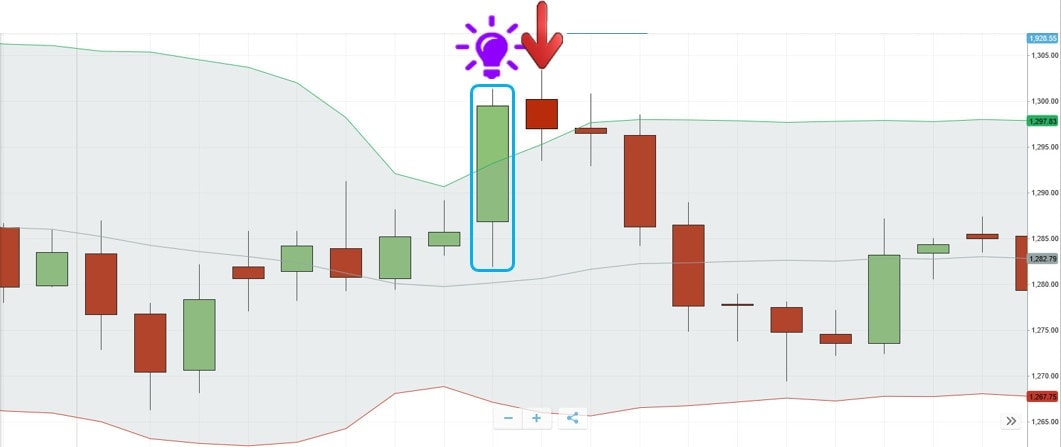
Open a SELL Order: When a Japanese candlestick closes completely outside the upper Bollinger Band or at a historical resistance zone. This suggests the market is temporarily overextended and likely to pull back.
Order-by-Order Trade Review
Trading Crude Oil CFDs
1st Order (Oil BUY): The daily candlestick closed sharply outside the lower Bollinger Band. Following our rules, we opened a BUY order immediately at the close of the candle. The price quickly reversed back into the bands, hitting our profit target and securing +$250.
4th Order (Oil BUY): Rather than breaking the bands, the price declined to a strong support zone established weeks prior. Because the price stabilized at support, we executed a BUY order. The support held, and the price rallied to secure another +$250 profit.

Trading Gold CFDs
2nd Order (Gold BUY): The daily candlestick closed below the lower band after sticking to it for two previous sessions. As the price showed signs of exhaustion, we entered a BUY order. The market rebounded, resulting in a +$250 profit.
3rd Order (Gold BUY): The price broke out of the lower band and hit a major historical support zone. This convergence of a Bollinger Band breakout and historical support provided a high-probability reversal signal. We opened a BUY order, which quickly yielded +$240.54 in profit.

Total Strategy Profits: $990.54. While this specific review produced a clean run of winners, remember that in real-world trading, you will encounter losing trades. Having a hard stop-loss is what prevents a single loss from wiping out the profits of your previous four successful trades.
Daily Routine of a Successful eToro Day Trader
Consistent profitability is built on a structured daily routine. Professional day traders treat trading as a business. Here is what a typical day looks like for a successful eToro day trader:
- 07:30 AM – Pre-Market Analysis: Scan global financial news. Check the economic calendar for high-impact releases (such as CPI prints, FOMC meetings, or OPEC oil production reports). High-impact economic news can cause massive spreads and extreme volatility, so professional day traders usually avoid opening trades 30 minutes before and after these events.
- 08:30 AM – Chart Preparation: Open eToro ProCharts. Mark key daily and weekly support and resistance zones for your watchlist assets. Set up your technical indicators (like Bollinger Bands or RSI) and define your trading boundaries for the day.
- 09:30 AM – Market Open & Execution: As the New York session opens, liquidity surges. Monitor your watchlist for setups. When a candlestick closes outside the Bollinger Band or touches a key support level with high volume, calculate your position size using the 2% risk limit, set your stop-loss and take-profit targets, and execute the trade.
- 12:00 PM – The Midday Lull: Around lunchtime in New York, trading volume dries up. Markets often become choppy, leading to false breakouts. Professional day traders step away from their screens during this period to rest and avoid overtrading.
- 03:00 PM – Session Wrap-up: Review any active positions. Close all open CFD trades before the session ends to ensure zero overnight exposure, avoiding swap fees and unexpected news gaps.
- 05:00 PM – The Trading Journal: Log all trades. Record the entry/exit prices, the emotional state you were in, whether you adhered to your rules, and the final profit/loss. Analyzing your journals at the end of every week is the key to identifying and correcting recurring trading mistakes.
eToro Day Trading vs. eToro Long-Term Investing
Before committing to a day trading style, you must evaluate whether it matches your capital size, risk tolerance, and time availability. The table below compares day trading with long-term investing on the eToro platform:
| Feature | eToro Day Trading | eToro Long-Term Investing |
|---|---|---|
| Primary Instruments | CFDs (Leveraged contracts, short selling) | Real assets (spot Stocks, ETFs, Crypto) |
| Holding Duration | Minutes to hours (closed same-day) | Months to years (buy and hold) |
| Leverage Usage | Yes (typically 5:1 to 30:1) | No (1:1 leverage, cash-funded) |
| Key Cost Drivers | Spreads, slippage, overnight fees (if held) | Spreads (primarily on crypto), withdrawal fees |
| Risk Profile | Extremely high; potential for rapid capital loss | Moderate; subject to long-term market cycles |
| Analysis Focus | Technical indicators, volume, price action | Fundamentals, earnings, macroeconomics |
| Time Required | High active commitment (several hours daily) | Low active commitment (weekly/monthly checks) |
Conclusion
Day Trading is a fast-paced, high-income-potential investment style that is less time-consuming once you establish a solid daily analysis and execution routine. A professional Day Trader can secure their trading plan within a short window, allowing them to balance their trading with other activities or a primary career. However, the time-saving benefits of day trading are only realized when you follow a robust risk management system.
Always remember that day trading leveraged CFDs on eToro requires calculated stop-loss parameters, strict adherence to the 2% capital risk rule, and the patience to avoid risky martingale or grid averaging setups. If you are a beginner, start by practicing your strategy using the $100,000 free virtual account on eToro. It is the safest way to gain market experience and develop the discipline required for long-term trading success.
Register an eToro Account NowGet $100,000 Free Virtual Funds for Practice
Frequently Asked Questions (FAQ)
Can you day trade on eToro?
Yes, day trading is fully possible on eToro. To day trade, you open and close CFD (or spot) positions within a single trading day. Day trading requires active technical analysis, managing spreads, and closing your positions before the daily market closes to avoid rollover charges.
What are the primary fees for day trading on eToro?
The primary fee for day trading is the spread (the difference between the buy and sell price). Because day traders open and close positions quickly, bid-ask spreads are the main trading cost. Additionally, if a leveraged CFD position is held overnight past 17:00 EST, an overnight (rollover) fee is applied.
Is eToro Copy Trading recommended for day trading?
No. Copy trading is not recommended for high-frequency day trading due to latency. When a Popular Investor opens a trade, a brief delay occurs before it replicates in your portfolio. This delay can lead to price slippage, which significantly cuts into profits on short-term trades.
What leverage limits are set on eToro?
Under ESMA regulations, leverage limits for retail accounts are capped: 30:1 for major currency pairs, 20:1 for minor currency pairs, Gold, and major indices, 10:1 for other commodities, 5:1 for individual stock CFDs, and 2:1 for cryptocurrencies where permitted.
What is a safe risk management strategy for day trading on eToro?
A professional risk management system includes applying the 2% rule (never risking more than 2% of account equity on a single trade) and setting a minimum 1:2 Risk-to-Reward ratio. You should also avoid averaging down, martingale, or grid averaging systems, as they can lead to rapid margin calls.


