


Hello, readers of howtotradeblog. It has been a long time since my last article – Mr. Joker – appeared on the blog. In today’s article, to mark my return, I will bring you a new, highly effective strategy to make money in Olymp Trade. Specifically, we will be focusing on trading gold in Olymp Trade to generate consistent profits for yourself. Let’s look at the underlying reasons why I selected gold as my primary asset to trade over the past few days, how the strategy works, and the exact steps you can take to reproduce these results safely.
Key Takeaways
- Asset Volatility: Gold (XAUUSD) is highly reactive to global economic shifts, inflation, and interest rate announcements, presenting major trend-following opportunities.
- Double Platforms: Olymp Trade offers both Fixed Time Trades (FTT) for short-term predictions and Forex mode for leveraged spread-based position trading.
- Techno-Tactical Mix: Combining the Exponential Moving Average (EMA 30) for trend bias and Price Action breakout patterns provides a reliable trade trigger system.
- Strict Risk Control: High-risk money management techniques like Martingale and grid averaging are account-killers; retail traders should strictly adhere to the 2% risk rule and a minimum 1:2 Risk-to-Reward ratio.
Register an Olymp Trade account NowGet $10,000 Free for beginners
Why Should We Choose Gold (XAUUSD) to Trade?
Gold has historically been regarded as the ultimate safe haven asset. In times of geopolitical turbulence, economic recessions, high inflation, or massive global disruption, investors flee riskier assets (such as stocks, high-yield bonds, and speculative currencies) and pour capital into gold. This persistent institutional demand triggers major, sustained price moves. When you are trading gold in Olymp Trade, these large fluctuations are exactly what you need to extract profits from the market.
Furthermore, gold exhibits unique technical characteristics. Unlike many major currency pairs that tend to range and chop, gold frequently enters long-term, directional trends. Once a trend is established on gold, it possesses strong momentum that can last for hours or even days. This makes it an ideal instrument for both Fixed Time Trades (FTT) and Forex mode. By understanding what drives gold prices, you can build a reliable directional bias before you even place your first trade.
Core Price Drivers of Gold (XAUUSD)
To succeed when trading gold, you must keep an eye on the fundamental pillars that influence its valuation. The primary price drivers include:
- The US Dollar (USD) Correlation: Gold is priced internationally in US Dollars (XAU/USD). Consequently, there is a strong inverse relationship between the two. When the US Dollar Index (DXY) is rising due to economic strength or high interest rates, gold prices typically fall because it becomes more expensive for foreign buyers. Conversely, when the USD weakens, gold prices usually rally.
- Real Interest Rates and Bond Yields: Gold is a non-yielding asset; it pays no interest or dividends. Therefore, it competes directly with government bonds. When US Treasury yields rise, the opportunity cost of holding gold increases, prompting investors to sell gold in favor of bonds. When yields plummet, gold becomes significantly more attractive.
- Inflation Hedging: As fiat currencies lose purchasing power due to central bank money printing and inflation, gold acts as a physical store of value. High inflation readings (such as CPI reports) often trigger instant upward momentum in the gold chart.
- Geopolitical Risk: Wars, trade disputes, and global political instability generate uncertainty. Investors hedge this risk by buying gold, making it highly volatile during major international news events.
Olymp Trade Mechanics: FTT vs. Forex Gold Trading
Olymp Trade allows you to participate in the gold market through two distinct modalities. Understanding the differences between these two modes is vital for structuring your risk management and execution methods.
Fixed Time Trades (FTT): FTT is a simplified binary-style trading mode where you predict whether the price of gold will be higher or lower than your entry price at the end of a specified duration (expiration time). Payouts are fixed (ranging from 80% to 92% of your investment amount). While FTT offers quick returns and requires no management of dynamic exit points, it exposes you to short-term market noise and requires a high win rate to remain profitable over time.
Forex Mode: Forex mode operates similarly to traditional CFD trading. You buy or sell contracts based on pip movements. The profit or loss is determined by how far the price moves in your predicted direction. You can apply multipliers (leverage) to boost your capital efficiency. Most importantly, Forex mode gives you absolute control over your trade management, allowing you to use Stop Losses (SL) to cap risk and Take Profits (TP) to lock in gains dynamically, as well as trailing stops to protect running profits.
Below is a comparative breakdown of these two models specifically for gold trading in Olymp Trade:
| Feature | Fixed Time Trading (FTT) | Forex Trading Mode |
|---|---|---|
| Risk Structure | Fixed loss capped at the investment amount per trade. | Variable risk managed via Stop Loss (SL) levels. |
| Payout Potential | Fixed return (typically 80%–92% depending on market status). | Unlimited profits determined by price distance and multiplier. |
| Time Constraints | Rigid expiration times (e.g., 1 min, 5 min, 15 min, 1 hour). | Flexible; trades can remain open indefinitely. |
| Leverage / Multipliers | Not applicable. | Available (e.g., x50, x100, x200 multipliers to boost profits). |
| Trade Management | Cannot adjust trade parameters after entry. | Dynamic exits; add to positions, partial close, trailing stop. |
How to Make Money When Trading Gold in Olymp Trade
Here are my actual trading results in Olymp Trade from December 16. Using a structured, rules-based approach, I executed 5 Fixed Time transactions with a total capital outlay of $700. This yielded over $400 in net profit. This result serves to illustrate one crucial point: making money when trading gold in Olymp Trade is not an impossible task. It only becomes difficult when you lack structured knowledge, emotional discipline, and a validated execution strategy.
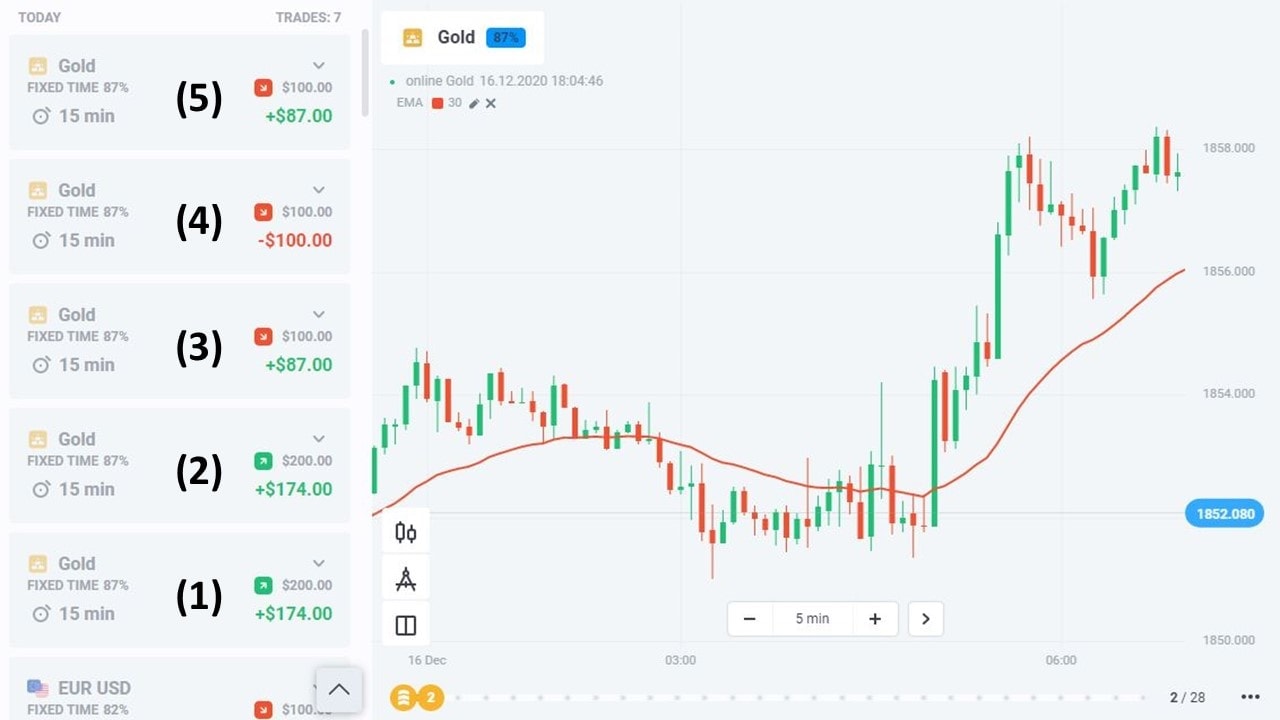
Please do not look at these winning trades as an invitation to jump into gold trading blindly. If you focus purely on the dollar amounts, you will likely end up losing your capital faster than you can imagine. The goal of this guide is to break down the exact technical system I used—built on the Exponential Moving Average (EMA) and price action breakout principles—so you can develop your own structured approach.
The Technical Framework: EMA and Price Action
To consistently capture profits, I combined two robust technical tools: the Exponential Moving Average (EMA) and price action breakout patterns. By overlaying trend direction with clean price setups, you create a filtered entry system that removes a large portion of market noise.
1. Defining the Trend with the EMA
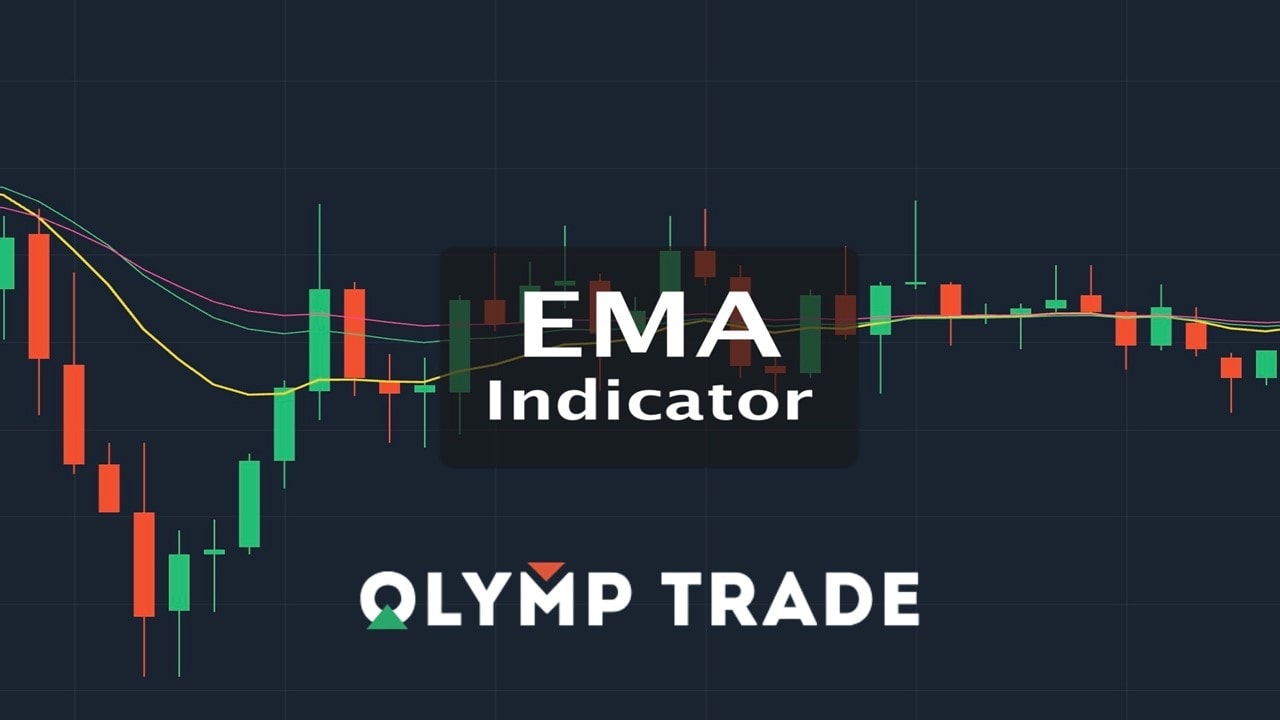
The EMA is a moving average indicator that reacts quickly to price changes because it assigns greater weight to the most recent candles. Unlike a Simple Moving Average (SMA), which can lag significantly, the EMA helps you identify the immediate trend direction. For gold, I utilize the **EMA 30** on the 5-minute chart.
- Bullish Trend Bias: If the price of gold is trading above the EMA 30 and the indicator is sloping upward, we only look for buy setups (UP orders).
- Bearish Trend Bias: If the price is below the EMA 30 and the line is sloping downward, we only look for sell setups (DOWN orders).
- Ranging Market: If the EMA 30 goes flat and weaves through the candlesticks, the market is in consolidation. We avoid trading during these periods as breakout signals become highly unreliable.
2. Price Action: Breakouts and Support/Resistance
Price action focuses on pure candlestick movements and structural levels without relying on lagging oscillators. The primary price action setup we look for is a **breakout of major horizontal levels**.
First, identify strong horizontal resistance (lines connecting prior swing highs) or support (lines connecting prior swing lows). When the gold price builds momentum and breaks past one of these levels with a **Marubozu candlestick** (a long-bodied candle with little to no wick), it indicates that institutional momentum has entered the market. The break signals that the prior range is over, and a new trend has begun.
3. Pullback Confirmation
Because gold is highly volatile, fakeouts (false breakouts) are common. To filter out low-probability trades, we often wait for a **pullback**. After the price breaks out of a resistance level, it frequently returns to retest that broken level (which should now act as new support). If a pullback candle hits this level or touches the EMA 30 line and shows rejection (leaving a tail or forming a bullish engulfing pattern), it confirms that buyers are defending the level, offering a high-probability entry.
Detailed Review of My 5 Gold Trades in Olymp Trade
To help you understand the practical application of this EMA and price action strategy, I will break down each of my five trades from December 16, detailing the setups, execution, and technical rationale.
1st Order: UP Trade (Resistance Breakout at $1854)
Setup: Gold had established a strong horizontal resistance level at $1854 on the 5-minute chart. The price had retested this level multiple times but failed to breach it. Concurrently, the EMA 30 was sloping upward, indicating that buying pressure was building beneath the resistance.
Trigger: A strong bullish candlestick broke cleanly through the $1854 level, closing above it. This confirmed that buyers had overwhelmed sellers at this key price point.
Execution: I opened an UP order with a 15-minute expiration time to allow the market enough breathing room to move upward, absorbing any immediate minor pullbacks.
Result: Win. Payout achieved as the price continued its upward trajectory.

2nd Order: UP Trade (Continuous Resistance Breakout at $1858)
Setup: Following the breakout at $1854, the market formed a minor consolidation range before establishing a new resistance level at $1858. The EMA 30 remained sloped upward, pointing to a continuation of the bullish trend.
Trigger: The price broke through the $1858 level with a large **Bullish Marubozu** candlestick. This candlestick shape has a large real body and very short wicks, signaling that buyers were in absolute control of the market from open to close.
Execution: I immediately opened another UP order, keeping the expiration aligned with the 5-minute candle structure.
Result: Win. The momentum carried the price higher, securing another successful trade.

3rd Order: DOWN Trade (Support Breakout)
Setup: Later in the session, the gold market structure shifted. The price failed to make new highs, and the EMA 30 flattened before sloping downward, confirming a bearish reversal. A key horizontal support level was established at the bottom of the range.
Trigger: A strong **Bearish Marubozu** candlestick closed cleanly below the horizontal support line, accompanied by the EMA 30 pointing downward.
Execution: I opened a DOWN order to follow the newly established bearish momentum.
Result: Win. The sellers pushed the gold price down rapidly, yielding a profit.

4th Order: DOWN Trade (The Loss)
Setup: The bearish trend appeared strong. The price hovered near a minor support level with the EMA 30 still pointing down. I looked for another breakout entry.
Trigger: An apparent breakout below the minor support level occurred. I executed a DOWN order based on the assumption that momentum would continue.
Result: Loss ($100 investment lost). The price reversed sharply upward immediately after my entry, forming a classic “false breakout” or “bear trap.”
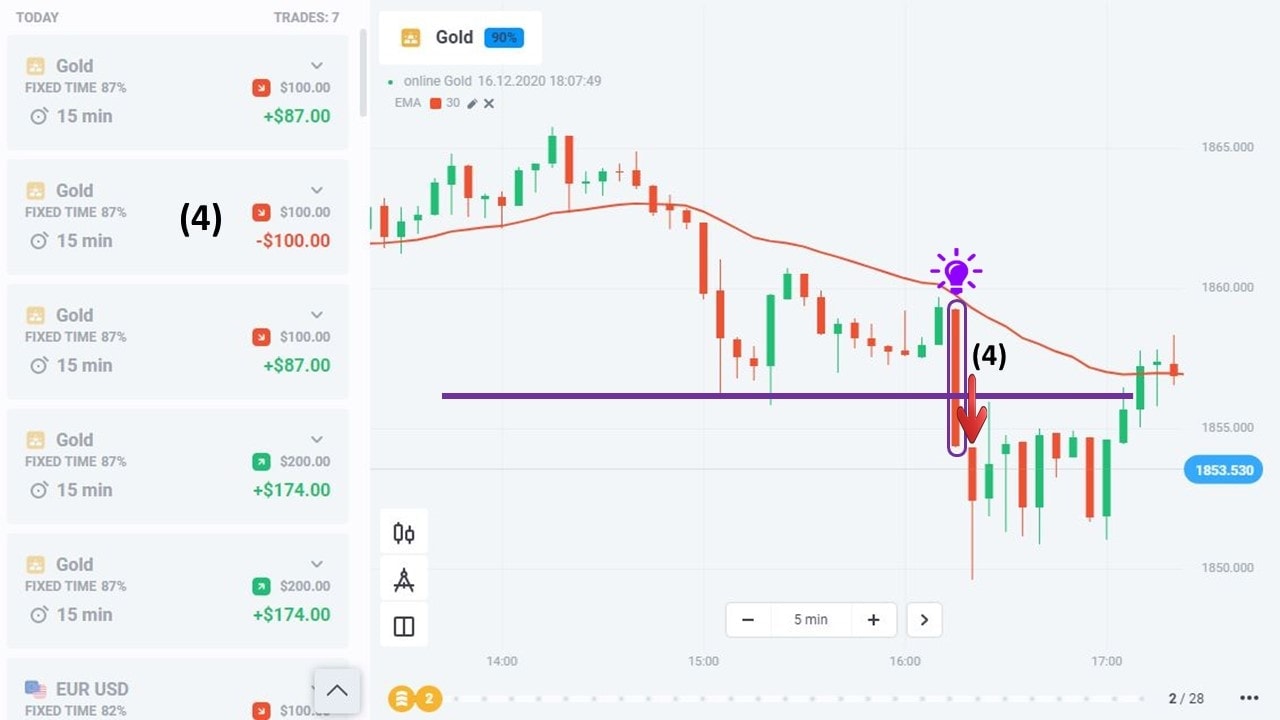
Post-Mortem of the Loss: Losing trades are an inevitable reality of technical trading. No system, indicator, or strategy has a 100% win rate. In this instance, I fell victim to a liquidity sweep where institutional buyers pushed the price back up to collect orders. The key to long-term success is to accept losses immediately, preserve your emotional balance, and never engage in revenge trading by doubling your stakes.
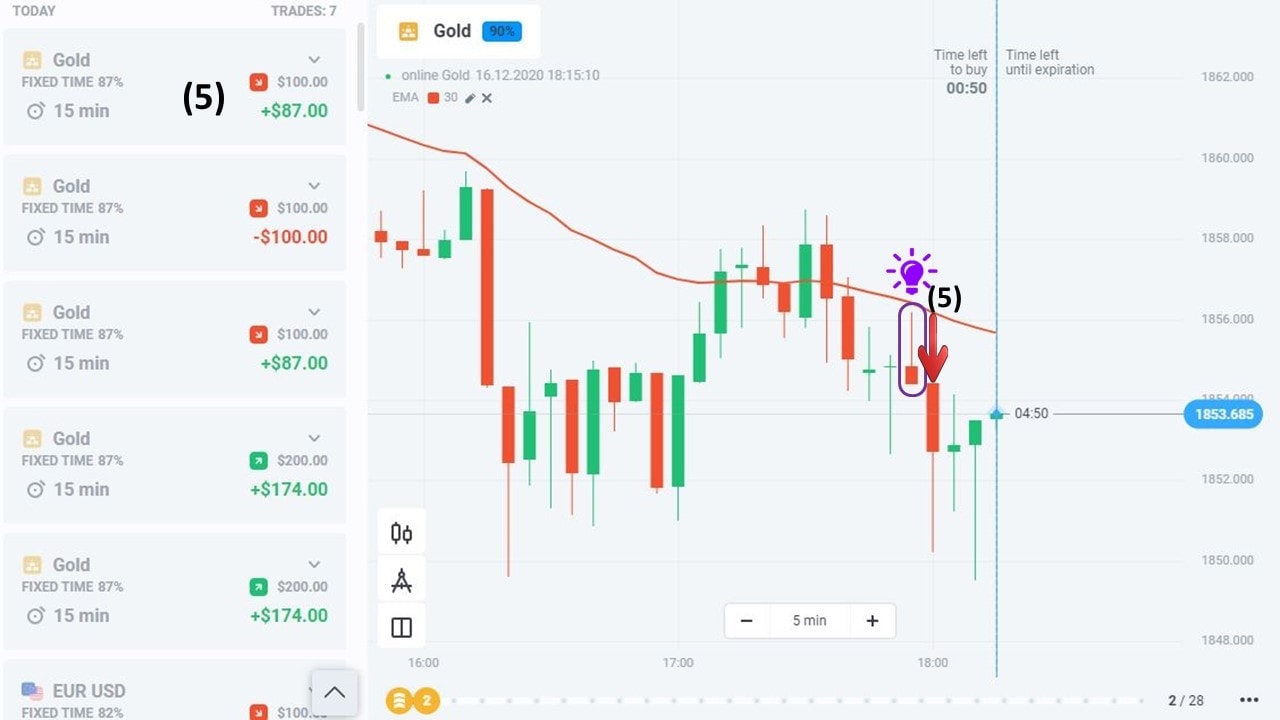
5th Order: DOWN Trade (The Pullback Entry)
Setup: Despite the previous loss, the overall trend bias remained bearish because the price stayed below the EMA 30 and the line continued to slope downward. Rather than chasing the breakout, I waited for the price to pull back to the EMA 30 dynamic resistance line.
Trigger: A pullback candlestick emerged. The price retraced to touch the EMA 30, met immediate resistance, and left a long upper wick, showing rejection of higher prices. I opened a DOWN order.
Result: Win. This pullback entry was highly profitable, recovering the loss from the 4th trade and sealing a successful overall trading session.
The Danger of Speculative Money Management: Why Martingale and Grid Systems Fail
When retail traders experience a loss—like my 4th order—they frequently turn to dangerous risk management techniques in a desperate bid to recover their funds. Two of the most destructive methods are **Martingale** and **Grid Averaging**.
The Martingale Trap: This method requires you to double your trade size after every losing trade (e.g., investing $10, then $20, $40, $80, $160, $320, etc.). The theory is that when you eventually win, the payout will cover all previous losses and yield a small profit. In reality, this is a dangerous mathematical fallacy. Because gold can enter massive, sustained trends, you can easily experience a string of 6 or 7 consecutive losses. By the time you reach the 7th trade, you must risk thousands of dollars just to win back your original $10. If you hit your platform limit or exhaust your account balance, your account is wiped out instantly.
The Grid Averaging Danger: Grid averaging (or loss-holding) involves opening additional buy orders as the gold price drops, or additional sell orders as it rises, without using a stop loss. Traders do this hoping the price will eventually reverse, allowing them to exit the entire basket of trades at a break-even or profit. Because gold can move $50 to $100 in a single direction during major economic events, holding losing positions and adding to them will quickly drain your free margin, triggering a forced liquidation (margin call) of your entire account.
The Professional Alternative: The 2% Rule and 1:2 Risk-to-Reward
To survive and thrive when trading gold in Olymp Trade, you must treat trading as a business rather than a game of chance. Replace aggressive strategies with these strict professional rules:
- The 2% Risk Rule: Never risk more than 1% to 2% of your total account balance on a single trade. If you have a $5,000 account, your maximum risk per trade should be capped at $100. This ensures that even a severe losing streak of 10 trades only drawdowns your account by 15-20%, leaving you with ample capital to recover.
- Target a 1:2 Risk-to-Reward Ratio: When trading in Forex mode, always set a Stop Loss and a Take Profit where the target profit is at least double the distance of your risk. For example, if you risk $50 on a trade (Stop Loss), your target profit (Take Profit) must be at least $100. By maintaining a 1:2 R:R, you only need to win 35% of your trades to remain profitable.
- Volume-Verified Entries: Do not guess turning points. Only enter trades when you see clear price action candles (like Marubozu or Pin Bars) that confirm institutional volume has entered the market.
Advanced Strategy Tips for Trading Gold in Olymp Trade
If you want to optimize your results when trading gold in Olymp Trade, implement these advanced operational guidelines:
1. Align with the Best Trading Sessions
Gold volatility is not distributed evenly throughout the day. The most profitable times to trade are during periods of peak liquidity, which occur when the major financial hubs are active. Specifically, target the **London and New York Session Overlap** (typically 13:00 to 17:00 UTC). During these hours, institutional trading desks are active, resulting in clean, strong trends and reduced spreads. Avoid trading gold during the late Asian session, as the market often ranges tightly, generating false breakout signals.
2. Master the Economic Calendar
Gold reacts instantly to US macroeconomic indicators. Before opening a chart, check the economic calendar for high-impact releases. The key events to watch include:
- Non-Farm Payrolls (NFP): Released on the first Friday of every month, this report regularly triggers massive volatility on XAUUSD.
- Consumer Price Index (CPI): As the primary measure of US inflation, CPI releases dictate the path of interest rates, driving gold prices.
- FOMC Meetings: Interest rate announcements and speeches by Federal Reserve members can spark sudden, multi-dollar moves on gold.
Pro Tip: Unless you are an experienced news-trader, avoid placing trades 15 minutes before and after these high-impact announcements. The massive slippage and widening spreads can cause unnecessary losses.
3. Use Longer Expirations on FTT
If you prefer FTT mode, avoid 1-minute and 2-minute expirations. Short-duration trades are heavily influenced by random price feed noise. By shifting to 15-minute or 30-minute expirations on the 5-minute chart, you allow your technical thesis (such as an EMA trend breakout) sufficient time to play out without being stopped out by temporary market noise.
Conclusion
Trading gold in Olymp Trade offers a pathway to consistent profitability, but only if you approach the market with a rule-based strategy and professional risk parameters. By combining the trend-following capability of the EMA 30 with the structural clarity of Price Action breakouts, you can identify high-probability setups. Remember to reject dangerous money management systems like Martingale, limit your risk to 2% per trade, and focus on continuous improvement. Test these strategies on a demo account, journal your results, and trade with discipline.
Register an Olymp Trade account NowGet $10,000 Free for beginners
Frequently Asked Questions (FAQ)
Is trading gold in Olymp Trade suitable for beginners?
Yes, but beginners should start on a demo account. Gold is highly volatile compared to currency pairs, meaning it can yield significant profits but also rapid losses if risk management rules are ignored.
What is the best indicator for trading gold on the platform?
The Exponential Moving Average (EMA), specifically the EMA 30, combined with clean Price Action (support, resistance, and Marubozu breakout candles) is highly effective for identifying trends and clean entry points.
Why should I avoid the Martingale strategy when trading gold?
Martingale requires you to double your trade size after a loss. Because gold trends strongly without immediate retracements, a prolonged trend against your position can force you into a long string of losses, leading to a complete account wipeout in minutes.
Should I trade gold using FTT or Forex mode on Olymp Trade?
It depends on your trading style. FTT is ideal if you prefer fixed risk and fixed time outcomes. Forex mode is superior for long-term strategies as it lets you manage trades dynamically, set Stop Loss/Take Profit levels, and benefit from unlimited trend extensions.
How does the US Dollar affect the price of gold?
Gold and the US Dollar generally share an inverse correlation. When the US Dollar strengthens (due to rate hikes or strong economic data), gold prices tend to fall. When the US Dollar weakens, gold prices typically rise.



I’ve been browsing online more than 2 hours today, yet
I never found any interesting article like yours.
It’s pretty worth enough for me. Personally, if all website owners and bloggers
made good content as you did, the internet will be a lot more useful than ever before.